


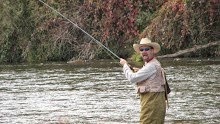
Last week, I took a couple of fellows out to teach them how to flyfish, and then ditched them to hit a hot spot just downstream in my kayak. The guys were perfectly okay with my leaving, and were focusing hard on just how to wear their flies and line, which means they have become quite accomplished flyfishermen, if I am any standard for the sport.
And so, after a bit of teaching and observing, I left them to flail the water at a nice tailout, jumped into my kayak and headed downstream after what had become a near-mythic creature in my life: American shad.
At the put-in on a nice stretch of the American River, I slipped past a group of shad fishermen cooking under a canopy, with full gas grill, ice chests of beverages, and conversations about darts and flies, rods, and the general gripes about work and/or not finding work. Shad fishermen, like most fishermen, are a rough lot, out to be themselves fully on the river. I passed trailers attached to trucks, and a drift boat coming in and one going out. And I noted, yet again, my surprise at the completely different experience with shad fishermen here from salmon fishermen.
I'll be blunt: Salmon fishermen are mean and not at all fun to fish around. "Combat fishing" is the term used to describe the lines of folks along the stretches where salmon come to spawn or stack up before heading further upstream. People rarely talk outside of their little cliques, they push and jockey for spots, and they grudgingly pull in their lines to give room, often with grumbles, at the "fish on!" holler from one lucky enough to hook into a beautiful chinook. They usually end the fight with the fish by dragging it up onto the bank, filleting it then and there, and throwing the carcass back into the water. To beat all, many folks in boats floating the deeper holes along the river tend to employ quite a bit of jigging action to their fishing...
I have fished for salmon along central California rivers for ten years, and although I am devastated by the crash in population, I am a tad relieved that I won't have to snuggle up to the crowds along the river.
So it was a shock when, Memorial Day Monday, I walked along the crowded shoreline and noted rows of shad fishermen, at times much closer to each other than salmon fishermen would have tolerated, talking rough but jovially to each other. I asked about the run, and was given very specific advice, "get right in between those two boats at the channel down there." When I showed up with my fly rod, nobody cared. One boat even pushed over and invited me in.
My luck that day was not with the fish, though I saw one man pull fish after fish up to his boat and gingerly remove them without letting them leave the water. I was there for food, but I was very appreciative of his respect. When I got back to my car, it had been broken into and my radio stolen (I thought for a second I was back in 1992), but I know it wasn't a shad fisherman who did it.
So Wednesday night I was more eager than ever to get out on the river. After setting up the fellas, I jumped in my boat.
I did mention that this fish had reached near-mythical proportions in my mind. Years ago, a fellow flyfisherman had told me that folks go out after shad here, although a "trash fish" for food, because they were the freshwater tarpon. They fought unlike any other fish in the river, he explained, a distant look in his eye. We never were able to get out after them. A couple of years later, when I had bought my first really nice fly rod, I hit the water with another veteran, who explained that these fish would tail walk, throw your fly, run your line completely out. They were amazing fish. However, that day it rained frozen rain upon us, and in his first cast trying out my new rod, it snapped just inches above the grip... so again, no fish.
Last year, I picked up John McPhee's book, "Founding Fish", and again read about the power and grace of this fish. But something more was there, too. The very name of the fish, Alossa sappidissima, means "most savory herring." McPhee had opened up a new world to me - this was an eating fish of unsurpassed taste! Recipe after recipe included in his book sealed the deal for me, but I had missed the run yet again!
This year, I was bound and determined to get out on the river.
New fish always pose the problem of confidence. I know when I hit the river for trout up in the Sierras that I will catch something. I'm pretty sure about my bass and bluegill spots. But, even worse than trying new places, new fish pose many questions, and if you aren't catching fish, then you don't know which to tweak - method, depth, fly? Is it the spot? Is the boat bothering them? Am I right over them instead of upstream? My first casts had this anxious feeling about them, but I had tried the one cure that had worked in the past, a trip to Bill Kiene's fly shop for great advice and a confidence boost. They had also given me a tip I'd have never thought up: A two nymph rig.
Just as I started to get nervous, I felt a good, solid, double tapping on my line. I set the hook, but missed. That's okay. I re-cast, the same amount of line, and within a minute a tap again. I set fast, and fish on! Only, this fish fought like no other fish I'd caught here, not even stripers. It ripped my line out, and I new it was going to break me off, but it stayed on. It ran every which way. It shook like a chinook. I imagined for an instant a giant steelhead, but I couldn't imagine anything going from zero to sixty as quickly as did this fish. After a few minutes, I thought: Alright, time to bring this in. I'd employ my tried-and-true rod technique to thoroughly confuse the fish, and net it quickly. This involves turning the rod parrallel and just above the water, perpendicular to the fish, then when I feel it turn, flipping my rod the other direction, keeping it perpendicular to the fish. Usually, I can have a trout lolling on the surface and in my net within a minute.
I flipped my rod, perpendicular to how I felt the fish on, and also keeping him perpendicular to the river flow. It didn't budge; in fact, if felt like it was tied to the river, like it owned the river. I immediately thought of a barndoor halibut, planing in the current. Then I was worried, and my confidence left me. The legend of the shad made flesh, and I a mere mortal. I thought, alright, I'll let this fish run its course.
Five minutes or so later, I landed my first American shad, a buck of about 2-3 pounds. I was elated, and shaken, but the most amazing part was yet to happen to me. As I pulled the fish in, I saw it: It was an ocean fish, here in my river! Iridescent blues, greens, and a silver like you see on mackerel or anchovies or other beautiful ocean fish. I thought of lines from a Mary Oliver poem: the slow pouring off of rainbows.
I pulled his gills and placed him in the floor of my kayak, took a breath and thanked. And I cast again.
Saturday, May 30, 2009


Thursday, May 7, 2009
Man and Fire
last week, a small, once-controlled brush fire outside of Santa Barbara exploded into a house-eating inferno, fueled by 100 degree temperatures and the Shakin Shakin Shakes, those Santa Ana winds. As of today, it is 80 percent contained, although additional winds are probable.
California is blessed with many natural wonders, and cursed, as well. We have mountains so full of snow that they were named it - Sierra Nevada. We have a two-river Delta (one of only a handful) that supplies 20 million people with drinking water. We have a gigantic coastline, huge, rugged, highly variable terrain, and our state claims multiple climates with dozens of microclimates. In the Summer, we are a desert, and in the winter, we are often inundated with deluges. But, we have changed our natural wonders to a great extent, and in these changes comes an increase in variation and intensity. The Sierra Nevada may one day be renamed the Sierra Seca. That river system's wildlife is quickly crashing, and the wonderfully varied and beautiful terrain can't seem to keep folks from wanting to build on it, to better enjoy its beauty, yes, but with the result that we find ourselves living by the whims of fickle Mother Nature.
We have also changed much of the flora of our beautiful state, and the effects of this paradigm-shift are felt most directly in the new nature of our wildfires.
Prior to Europeans, California's flora and fauna developed with a particular relationship to fire and each other. Most of our herbivores were browsers, pushed by a considerably large number of large predators, primarily wolves and very large brown bears, but also mountain lions, bobcats and the like. Our primary flora, therefore, were wildflowers and slow-growing bunch grasses. The animals seeded large areas of land, and many plants only seeded once every few years. Fires regimes, caused by lightning and people, usually burned with a low intensity, because the slow-growing bunch grasses kept green all year, and protected their roots with tight "bunches" of grass blades. Forests of huge oaks, pines, and redwoods required these fires, as their seeds needed heat to open, and their seedlings needed light and nutrients.
This habitat regime changed dramatically with the arrival of Europeans. We brought livestock that ate entire plants, and we kept them protected and in the same places for longer periods of time. We also fed them grass seed from our native lands, grasses which had developed a relationship with very different animals. The new grasses, which grow, seed, and die within a few months, quickly replaced the slower-developing native habitat, which wasn't used to being eaten completely down to the roots. Within a short period of time, much of California changed completely, giving our state its golden hue during the Summer, and bringing on a dramatic shift in the nature of fire.
The new grasses and weeds die quickly, creating fuel from the tip right down into the soil. Fires set in this fuel often burn far hotter, burn soil habitat and seeds, and leave a scorched waste. They also burn into the upper canopies of the trees, killing many adult trees that had survived the previous fire patterns for hundreds of years. This is why we instituted a fire-suppression program over 150 years ago, and in so doing we allowed the buildup of deadwood, leaves, and other combustible materials. Consider this in light of projected hotter and drier weather patterns, and we have a serious problem.
Now that many more of us are living close to these wild and altered landscapes, it is imperative that we do something to both improve habitat and fire. Right now, many are under the impression that a completely barren "defensible space" as far as you can make it is the best thing to do. But, wildland firefighters know that the best thing we can do is to eliminate the non-native grasses and forest duff that fuel these monsters, and build houses that don't catch fire so easily. No amount of defensible space could have saved most of the homes in Santa Barbara, because 40 mile-an-hour winds will carry sparks well past any clearings, and even over large freeways and the like. However, if those sparks land on green plants or metal roofs, and the fires from which they came were burning low and through the underbrush instead of licking hundreds of feet into the air, we would all be much safer.
The answers are easy, but expensive. They also have the great upside of improving ecological habitat as well as human safety. The alternative, however, is a complex series of ever-more-useless attempts to postpone the inevitable, also expensive, while encouraging further ecological degradation. Which way shall we go?
Tuesday, May 5, 2009
A neat way to look at things
Phillip Loughlin has another great post over at Hog Blog, on an ethical conversation that comes up from time to time over there, specifically referring to high-fence hunting operations, but more generally on the idea of ethics, the law, and hunting practices. I hope I haven't driven Phillip to distraction with my commentary there, but it is such a great place to get good, thoughtful debate that I can't resist.
However, it's actually a comment from NorCal Cazadora at that post that really got me to thinking. Referring to the concept of sport hunting, she wrote:
"...I still disagree on the notion of “sport.” True - I don’t have to hunt for food; I could go to the grocery store like my neighbors do. But that really buys into my neighbors’ perspective as the right and true perspective. I prefer to turn the tables and say my neighbors don’t have to go to the grocery store - they could hunt, forage and garden for food. Some people enjoy convenience of driving to the store; I enjoy the fulfillment of the hunt."
This idea blew me away. I had been grappling with the notion of 'sport' in hunting and fishing for some time, understanding that I don't have to do so to eat. However, one reason I choose to hunt is to provide a bit for my family (jokes about my prowess aside), and because I don't like the mass production process we use to acquire meat in California.
What Cazadora did was open up that choice to those who do not hunt, give it equality and credibility, and blow open the whole notion of food for everybody. She also removed some of the elitism, both fatalistic and natural, I've felt creeping more and more into hunting.
I thought about this idea: People could choose not to buy beef and pork from huge, concentrated feedlots; they could, instead, pop squirrels or get to know their farmer better, or raise their own. Many people who argue that sustainably-raised food is prohibitively expensive also pay for cable TV, a cell phone for each of their kids, a station wagon on steroids (oh, I mean a sport-utility vehicle), etc. Not that any of those are wrong in each case, just that they are choices. Each of those choices has impact, too, and those impacts should be considered along with their benefits (the economist in me, I suppose), but a choice in acquiring food does seem to me deeper than a choice to play tennis.
If I were any good at either tennis or hunting, however, this opinion may have been different...
Now, this doesn't completely get at my discomfort with hunting as "sport", although I do understand it and believe that it is a concept to keep close, and not completely to disagree with. However, whenever I think of it, I immediately think of this quotation from Chief Sitting Bull, that, "when the buffalo are gone, we will hunt mice, for we are hunters, and we want our freedom." I can't see it the same if it were said, "and when the tennis balls are gone, we will play tennis with pingpong balls, for we are tennis players, and we want our freedom." There is a notion of freedom in hunting that goes beyond mere choice to include acquisition of food, interaction with the world, a connection to other things here. It puts us directly in touch with sacrifices made on our behalf, and makes us aware of our power and responsibility...

Wednesday, April 29, 2009
Husbandry and Hope

Today, I'm officially joining some form of blogging unity. The good folks at Heifer International are holding a, "Unite for Hunger and Hope" blogging rally of sorts, and as a fan of their work, I thought I'd offer this morning's post for anybody reading.
If you don't know them, Heifer International paraphrases the old fishing and eating line, and gives folks goats, sheep, cattle, fowl, and quite possibly other domestic animals, as a means to help end poverty and hunger. The idea is that by providing animals that produce milk, eggs, etc., as well as training, they offer sustainable means to providing nutrition.
I created this blog to talk about the connections between folks and nature, and so I often find myself blogging about the effects of acquiring food, or the means. For me (and I'm sure most of you reading this), this is easy enough: we go to the store. But for one third of our world's folks, that just isn't possible. The World Health Organization estimates that over two billion people are starving today. Right now.
Please consider that.
Then, please consider heading over to one of these organizations (or Heifer International) to see if there is anything you can do:
Sportsmen Against Hunger (through SCI)
Feeding America (formerly America's Second Harvest)
UN World Food Program (to which a great, James Beard-nominated blogger donates an auction prize to each year)
Now, I do not personally endorse or work for any of these organizations, but they have decent track records, and seem to be really trying.
Sunday, April 26, 2009
Great essay on stewardship vs. standards

For those who don't know me, let me explain that when I decide to take on a new hobby or endeavour, such as bowmaking or tying flies, I do a tremendous amount of reading before actually getting up the courage to buy something. In fact, I probably drive my wife to distraction and bore her to tears, following her around the house with a book, reading to her about the fascinating art and science of tillering, or some such thing.
So, when we decided to try raising ducks, I read as much as I could online and from the library before actually ordering ducklings. And, because our property is small and urban, I found myself at a number of sustainable-ag., Mother Earth or Bible-heavy places, from people who are trying in one small way or another to opt-out, and found very interesting reading from sincere people trying to better understand their relationships to the world and other folks. A bit preachy at times, but I don't mind that nearly as much as most others, I've found (religious studies student that I am), and I think the admonition to allow free speech extends beyond the mere libertarian notion to leave other people alone.
It was great, then, to stumble upon an essay on stewardship by David Walbert who runs a website called the New Agrarian. He hasn't posted a blog entry since January, but the essay is well-wrought and bears some reading.
Now, I would try to explain his point, but I think he does so in a very concise manner here:
"Organic agriculture now seems in danger of forsaking stewardship for mere management. That, ultimately, is the goal of the National Organic Standards — to codify the practice of “organic” agriculture and reduce it to a set of principles for managing the land. I am not going to criticize the organic standards as standards; that is, I am not going to quibble about whether a better set of standards could have been written. They represent a significant improvement over most agriculture in the United States, and our national agriculture would surely be improved if every farmer adopted them. Organic standards are a great step forward in farm management. But they are not, and cannot be, a guide to farm stewardship — at least not on their own.
The problem, I think, is in the very idea of standards. The purpose of standards, ultimately, is to do away with individualization, with variation, with diversity — to standardize. And I do not believe that farming, or food, should be standardized. Standardization is the cause of most of the problems organic farming was meant to solve or avoid: lifeless food, distant producers and consumers, farm consolidation and rural depopulation. What we need, in American agriculture and American society, is not more standards, not better management. We need more stewardship..."
"Or consider the uses of “stewardship” in the Bible, which is, in Western culture, the source of most of that word’s connotations. The original, literal meaning of a steward was one who took care of a household, and descriptions of good stewards appear throughout the Bible. A steward is more than a good manager; he is “faithful,” “wise,” a member of the household he stewards and a loyal servant to his master, with a personal connection to both. Hence it is stewardship that becomes the model for the apostles’ relationship to God and to their church. They describe Christians as “stewards of the mysteries of God” (I Cor. 4.1) and as “stewards of God’s varied grace” (I Peter 4.7). One could not sensibly be a manager of God’s grace and mysteries"A very interesting author with a strong and nuanced understanding of these concepts.
If you get a chance, click on over there and read it.
Saturday, April 25, 2009
Carbon Emissions by Quintiles (warning, economics jargon!)
 When it comes to emitting carbon, nobody beats the developed countries. Although on par with China's emissions as of now, the per capita comparison (~ 7 1/2 billion metric tons of CO2 divided by ~300,000,000 in the US; for China add one billion to the second number) is no comparison. And it can be argued that the vast, vast majority of China's emissions come only as a result of US emissions.
Now, let's drop a bomblet into population growth people's proper, organized, and simplistic worldview: The same countries with the highest per capita emissions are, with one exception, shrinking in population.
You see, with basic economic development (electrical & transportation infrastructure) and with women's education (even just finishing elementary education), population growth is curbed to nearly parity, and continues dropping with a country's improvements in quality of life and social safety nets. And this occurs almost without regard to social traditions and customs.
The real problem with carbon emissions is that we have based our transportation and mass-production infrastructures on one ingredient, petroleum. As people become more wealthy, they consume more petroleum-heavy stuff. In order to shift away from carbon emissions, we need to shift to alternative forms. This shift, as I see it, must include some way to ease the blow to folks who can't otherwise afford it, because transitions of this magnitude always move in fits and starts, and not smoothly.
That's where the title of this post comes in. I've been looking for data that separates carbon emissions into socioeconomic quintiles, or, fifths of the population separated by their relative wealth. All the data I'm finding right now are numbers like total carbon emissions for a country, or per capita carbon emissions, or, projected growth in carbon emissions based on previous years' growth (those can be thrown out the window this year). Even better would be to add in geographic location.
I know that wealthier people emit more carbon than poorer people, as a rule of consumption. What I am sick of hearing from wealthier people are admonitions that to save the planet "we" all need to stop having babies and use mass transit. Now, mass transit is important, but living close to where you work is better, so that little sleight-of-hand on the part of many wealthier folks to ignore the problem with housing says a lot. And the myth of a looming population boom is another illusion.
Again, the real problem is use of petroleum, that's it. And, without a doubt, rich people use far more petroleum than poor people (and tend to have more babies and use less mass transit, too). What I would like to see are data showing just how much more petroleum is consumed by people in the top 20% of income earners in the US, vs. the bottom 20%. I'm going to go out on a limb and guess that it's probably an order of magnitude greater at the top.
But, similar to rates of mass transit use by income level and birth rates by income level in the US, I have yet to find it...
Friday, April 24, 2009
Agrarianism and farm subsidies

Recently, I've become a farmer... not really, but I sure felt like it after buying a hay bale for my ducklings. Well, we've planted over 40 fruits and vegetables in our backyard this year, just to see how things work out, and with an initial goal of 1 full meal produced at our house per week once we get to harvesting and our ducks commence to layin'.
Of course, one could wax poetical-philosophical-religious-economical-environmental about all the benefits of gardening and animal husbandry. Of those who do it well, I recommend Michael Pollan, Wendell Berry, and that fella from Polyface Farms. And though I love that stuff, lately I've found myself reading much more practical writings, most of it published over at Storey.
I will say that kids (and adults!) should raise animals at some point in life, and if at all possible (as I've just learned), raise both for happiness (like a dog) and for food-production or some other practical benefit (like guard duty or hunting). Your responsibilities and relationships are subtly different, but both are valuable.
Now, on to the political sphere, just to make an observation. When Obama first picked Gov. Vilsack to run the USDA, I was more than a little bummed. In my opinion, the biggest improvements in habitat and climate change are going to have to take place around food. Production, transportation, and processing use up tremendous amounts of energy, and the types of foods and our reliance on a mass-production system is seeming to come up against some pretty heavy laws of nature, especially around plant types and nitrogen from petroleum. Also, as Pollan pointed out in Omnivore's Dilemma, it is pretty hard to keep a 6-12% annual return to shareholders if people only eat around 2,000 Calories and our population remains static.
However, when I learned of the Administration's proposal to cut subsidies to large farms, I was overjoyed, and in theory, this could be an idea to be embraced by conservative and liberal alike. Unfortunately, they have backpeddled some from the initial statement by Obama to, "end direct payments to large agribusinesses that don't need them." Nevertheless, for Secretary Vilsack to back some kind of reform here is a huge deal.

And the pictures? At the top is our garden twenty-six days ago, and here it is now...
Subscribe to:
Posts (Atom)