


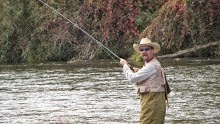
© Joshua Stark 2015
First off, I must admit it -- I am a gun nut.
This may come as a surprise to many, many of my friends and colleagues, since I don't work in a field where guns get talked about much, I don't have a political affiliation where being a gun nut is held in high regard, and I don't often even pick up magazines or books anymore that refer to guns.
Contrary to what many may think -- and my birth certificate -- I'm also an 80 year-old man (on the inside), and so set in my ways, and I haven't kept up with all the newfangled gun stuff ("newfangled" probably being any caliber that came out after the .280). I am especially turned off by the latest fetish with the AR platforms -- maybe because I'm a bit of a gun snob (guns are metal and wood, not a bunch of plastic molding), maybe because I'm concerned about high-capacity magazines, and maybe because I'm turned off by the less-than-subtle racism, rampant indignant victim mentality, and rabid anti-American, pro-Confederacy bluster that all-too often comes along with it. Also, the .223 is a worthless cartridge for my uses (I don't seal hunt or varmint hunt).
flx1247rg
But, I do own a large number of guns. These include two deer rifles (one bolt-action .270, one lever-action 30-30), five shotguns (two side-by-side double barrels in 12 and 20 gauge, one over/under double barrel 12 gauge, one single-shot 20 gauge, and one pump-action 12 gauge), and one pistol (a single-action .22/.22 magnum).
To my liberal friends, this may be considered a not-so-small arsenal. To my conservative friends, it is dangerously lacking in anything appropriate for personal defense. To my gun-snob friends, the cache has no caché (apart from my not-quite-yet-functional 1887 Greener side-by-side, which would be given a slight nod).
Not one of my guns is available for home defense, should the need ever arise (pray God it doesn't). No, they are all locked in a safe -- unloaded, and separate from the ammunition. Instead, we have the standard strategically-placed Large Stick, various long knives, and a hatchet I'm sure I could find if I had the time to spring out of bed and dig through the backpacks. We also have a MagLite (not the mini version, mind you, but the full-on model made so popular by Ben Stiller in "Night at the Museum").
The purpose for my guns is that I hunt with them (except one). But I would be lying if I didn't say that I really, really like my guns.
To be completely honest, like most kids, I've liked guns ever since the first time I heard about them, and I have no idea when that happened. All I can say is, from the time I can remember, I was already fascinated by ballistics, the fit and finish of wood to metal, and the various capabilities, provenance and mystique of certain calibers, gauges and models.
This love didn't come from my family. My Dad only had one gun -- a Winchester model 20 single-shot 20 gauge that kicked like a 12. He'd hunted some when he was younger, but he wasn't a "hunter". He was (and remains) a working-class intellectual -- an English major mud-logger -- but the tomes filling his bookshelves are not Ruark nor Capstick. Hemingway, yes -- but moreso Shakespeare, Faulker, Vonnegut, Merton; treatises on religious philosophy and ethics, and the Great Works.
My interest in guns did come naturally, inextricably linked with my being completely head-over-heels in love with the Outdoors. We fished all the time, and I ran barefoot through miles of corn fields, ditches and levees. I read National Geographics, Field & Stream and Outdoor Life cover-to-cover, along with Olaus Murie's "Field Guide to North American Mammal Tracks". I watched for birds, and we bought a handheld spotlight and drove the empty levees in search of foxes, coyotes, skunks and other marshland denizens.
And I hunted. And hunted.
I also kept up with gun-tech. In high school, I did four years of rifle team, and earned my varsity block my Freshman year. I hung out with a couple of gun nuts, guys with modified Ruger 10/22's, guys shooting 22-250's and Thompson/Center pistols. I can still make a cop feel comfortable by rambling on about the good points of a .40 cal over a 9mm. Target practice and shooting clays is fun -- really fun!
But, I am torn today.
Yes, guns are just tools -- and tools have special purposes. Hammers
are really good at nailing; drills are really good at drilling. I think you know where this leads...
I see the horrific impacts of so many guns on streets, amid rampant poverty and powerlessness. I do not believe that the 2nd Amendment guarantees a right to private ownership of any and every weapon (else we'd have to allow for nuclear armaments owned by private citizens), so I'm okay with drawing lines (though I don't know where those lines are). But, I also find myself cheering on the female Peshmerga Kurdish troops and women demonstrating empowered equality on U.N. missions in Africa. If I'm happy to see women empowered through being armed (and to be honest, in these cases being armed is a vital part of their empowerment), then why not my own sisters here at home?
I know that gun ownership carries with it a tremendous power and responsibility, and, as a leftist, I don't completely trust that power in the hands of government (especially where I see that government failing to protect many poor folks). As a Christian, however, I see the gun as a crutch and an obstacle to real power and transformation. I guess I'm torn like Hamlet, only I don't have to deal with it face-to-face like that poor bastard.
I don't have an answer to the violence of our society. I know fewer people would be harmed, physically, with fewer arms, but I don't see the disarming of American society going so well in reality. In the meantime, I see the weak preying on the weaker with arms, and I wonder how best we might protect them.
But when it comes to my own guns, it has little to do with ideas of protection. I enjoy guns like I enjoy knives and cast-iron pans, binoculars and bows. I like to look at the really nice ones, then, when I can afford one, I might pick up one of the cheaper ones.
Showing posts with label ethics. Show all posts
Showing posts with label ethics. Show all posts
Sunday, November 8, 2015


Wednesday, January 18, 2012
Trying again: Let's start with frankenfish and consumers' right to know
© 2012 Joshua Stark
According to some producers, wild salmon just don't grow fast enough. Oh sure, a Chinook salmon can reach 40+ pounds in two years, feeding for free and adding to the health of our lands and waters as it does, but this kind of willy-nilly public resource just doesn't cut it for those who wish to have complete control over their market. So in the name of profit, these folks have genetically engineered a species of salmon that grows over twice as fast as wild fish. Meant to be farmed in closed systems, these GE salmon will be fed by fishing for baitfish, presumably, and will not be allowed to enter our oceans, for fear that they will out-compete and destroy wild salmon. First, however, the producers of this fish must get past the FDA, which doesn't look like too big a hurdle.
While the FDA wrestles with the question of legalizing GE salmon for consumers, California is considering whether or not to require labels identifying such meat as GE in the marketplace. And while I might address the basic question of even allowing GE salmon at some future point, right now I want to address consumer knowledge in the marketplace.
This, of course, is a no-brainer outside of the halls of governance: Libertarians to Socialists agree that consumers have the right to know where and how their food comes to be. Even the opponents of the labeling bill (AB 88) couch their opposition in a manner that acknowledges some leeway in labeling requirements, arguing not that they shouldn't be labeled, per se, but that such requirements are the responsibility of the federal government, not the State.
In reality, the bill's opponents are concerned that if consumers know what they are buying, they will probably choose not to buy it (about 50% say they wouldn't). Really, consumer choice is the issue here, and California has every right to require labeling.
According to some producers, wild salmon just don't grow fast enough. Oh sure, a Chinook salmon can reach 40+ pounds in two years, feeding for free and adding to the health of our lands and waters as it does, but this kind of willy-nilly public resource just doesn't cut it for those who wish to have complete control over their market. So in the name of profit, these folks have genetically engineered a species of salmon that grows over twice as fast as wild fish. Meant to be farmed in closed systems, these GE salmon will be fed by fishing for baitfish, presumably, and will not be allowed to enter our oceans, for fear that they will out-compete and destroy wild salmon. First, however, the producers of this fish must get past the FDA, which doesn't look like too big a hurdle.
While the FDA wrestles with the question of legalizing GE salmon for consumers, California is considering whether or not to require labels identifying such meat as GE in the marketplace. And while I might address the basic question of even allowing GE salmon at some future point, right now I want to address consumer knowledge in the marketplace.
This, of course, is a no-brainer outside of the halls of governance: Libertarians to Socialists agree that consumers have the right to know where and how their food comes to be. Even the opponents of the labeling bill (AB 88) couch their opposition in a manner that acknowledges some leeway in labeling requirements, arguing not that they shouldn't be labeled, per se, but that such requirements are the responsibility of the federal government, not the State.
In reality, the bill's opponents are concerned that if consumers know what they are buying, they will probably choose not to buy it (about 50% say they wouldn't). Really, consumer choice is the issue here, and California has every right to require labeling.
Thursday, October 6, 2011
What is the California Delta to you?
© 2011 Joshua Stark
Dan Bacher has an update on Delta issues - noting that federal representatives of the Delta and North Coast recently met with the new Delta Czar, Jerry Meral. Their reason: To let him know that they have "grave concerns" (Mr. Bacher's language) about the Bay-Delta Conservation Plan. Add their voice to the many groups who've been involved for years fighting to make the Delta whole and healthy.
According to Mr. Bacher, the Reps.' concerns are over a peripheral canal. However, if you read the quotations, it sounds like those representatives are not as adamant about opposing a canal as is Mr. Bacher. This is too bad, and we constituents need to let them know that we want solid, explicit language opposing any conveyance around the Delta.
Make no mistake: Any peripheral canal would be an ecological compromise, at best; at worst, it would be an ecological and economic disaster for a fertile, diverse, unique region.
Everybody rips on the Delta, but the Delta is California's crown jewel, the source of our very life: from its water, the foods that come from its amazing soil (with no need to go against gravity), and its unique habitats. From the way it is talked about in the news and in so many watercooler conversations, you would think that it is a festering sore on the face of the Earth, a cesspool of pollution, devastation and death just waiting for a catastrophe to rip it wide open and spread famine everywhere. But, we have made ugly in concept something that is beautiful in fact - even now - and we do it because we do not understand our physical connection to it.
You, who drink water in Los Angeles, water that is pumped hundreds of miles and over an entire mountain range, you are connected to the Delta: It infuses your cells, hydrates your body, helps fire your synapses.
You, who spray water to ever-saltier flats on the West Central Valley, you are connected to the Delta: It lines your pockets, pays your kids' tuitions, keeps your workers happy.
And we, throughout the world, who buy California produce, we are all connected to the Delta: It grows the largest agricultural industry on Earth, it builds our muscles and bones, forms our staffs of life, grows our children's eyes and brains. We sanctify it, pray over it, cook it up, add it to our very selves. We are made of the Delta.
And this is good.
But if we are to continue to benefit from it, then we must treat it right. Many billions of other lives depend on the Delta, too, and the Delta, as any ecosystem, depends upon those lives for its own health. There is no separation of a wetlands habitat from its water without loss and significant change, and we, as Americans, have taken on the responsibility of caring for those creatures we have harmed.
Mr. Bacher notes a sad new record set this year: more Sacramento splittail minnows were killed at the pumps this year than any other. Nine million little lives lost for the pumps, while more water was pumped than ever before.
All of this that is the Delta - the devastation as well as the vitality, goes into those things we put in our bodies to keep ourselves whole.
So next time you start to think about the Delta as a horrible place, just remember: The Delta is You.
Dan Bacher has an update on Delta issues - noting that federal representatives of the Delta and North Coast recently met with the new Delta Czar, Jerry Meral. Their reason: To let him know that they have "grave concerns" (Mr. Bacher's language) about the Bay-Delta Conservation Plan. Add their voice to the many groups who've been involved for years fighting to make the Delta whole and healthy.
According to Mr. Bacher, the Reps.' concerns are over a peripheral canal. However, if you read the quotations, it sounds like those representatives are not as adamant about opposing a canal as is Mr. Bacher. This is too bad, and we constituents need to let them know that we want solid, explicit language opposing any conveyance around the Delta.
Make no mistake: Any peripheral canal would be an ecological compromise, at best; at worst, it would be an ecological and economic disaster for a fertile, diverse, unique region.
Everybody rips on the Delta, but the Delta is California's crown jewel, the source of our very life: from its water, the foods that come from its amazing soil (with no need to go against gravity), and its unique habitats. From the way it is talked about in the news and in so many watercooler conversations, you would think that it is a festering sore on the face of the Earth, a cesspool of pollution, devastation and death just waiting for a catastrophe to rip it wide open and spread famine everywhere. But, we have made ugly in concept something that is beautiful in fact - even now - and we do it because we do not understand our physical connection to it.
You, who drink water in Los Angeles, water that is pumped hundreds of miles and over an entire mountain range, you are connected to the Delta: It infuses your cells, hydrates your body, helps fire your synapses.
You, who spray water to ever-saltier flats on the West Central Valley, you are connected to the Delta: It lines your pockets, pays your kids' tuitions, keeps your workers happy.
And we, throughout the world, who buy California produce, we are all connected to the Delta: It grows the largest agricultural industry on Earth, it builds our muscles and bones, forms our staffs of life, grows our children's eyes and brains. We sanctify it, pray over it, cook it up, add it to our very selves. We are made of the Delta.
And this is good.
But if we are to continue to benefit from it, then we must treat it right. Many billions of other lives depend on the Delta, too, and the Delta, as any ecosystem, depends upon those lives for its own health. There is no separation of a wetlands habitat from its water without loss and significant change, and we, as Americans, have taken on the responsibility of caring for those creatures we have harmed.
Mr. Bacher notes a sad new record set this year: more Sacramento splittail minnows were killed at the pumps this year than any other. Nine million little lives lost for the pumps, while more water was pumped than ever before.
All of this that is the Delta - the devastation as well as the vitality, goes into those things we put in our bodies to keep ourselves whole.
So next time you start to think about the Delta as a horrible place, just remember: The Delta is You.
Tuesday, September 27, 2011
Professor Mankiw's frustrating comment - with no chance to comment!
© 2011 Joshua Stark
Sorry for the non-environmental post, but the Harvard Econ. Professor Greg Mankiw has me a tad frustrated this morning.
I'm no economist, and so, if he cared to, I'm sure Mr. Mankiw could come in and take apart my comments here, (frankly, I'd love that, because I want an accurate representation of economics out in the public, and where I'm mistaken, I want to be corrected). My real problem is that the Professor posts to a blog, but doesn't allow comments.
First, I would hope Mr. Mankiw would understand that the interactive nature of the internet makes it a world-changing phenomenon, and participate wholeheartedly in this interaction. Second, I think by opening comments, Mr. Mankiw would watch his own posting a bit more carefully. Case in point:
I'm poking through the cadre of economic minds on-line (starting at Env-Econ, of course) this morning, and I come across a little post by Prof. Mankiw. He ends this three-sentence post with:
"If you can remember only one fact, make it this one: The middle class (middle quintile) pays 14.1 percent of its income in federal taxes, while the rich (top tenth of one percent of the population) pay 30.4 percent."
Of course, I'm frustrated by this comment, because it misses a basic economic concept, "diminishing marginal utility". But, when I scroll to the bottom of the page to respond, I find no way to comment!
So, I'm taking time to point out a couple of mistakes that Mr. Mankiw makes in his implication (as I understand it, he is implying here that our federal tax system is sufficiently progressive).
First of all, as he points out, the richest 1/10 of 1% pay about double in "federal taxes" (we'll get to that definition in a minute) what the middle quintile pays. My immediate question: What is 14% to a person making the middle quintile vs. 30% to one of the richest 1/10th? So, I follow the link he posted, and I find that the middle quintile is defined as people making between ~ $34k and $62k, while the richest 1/10th are defined as making over about $2,468,000.
Then I ask: What is the marginal utility of this money - the relative impact of 14% on $34k ($4760) vs. 30% on $2,468,000 ($740,400)? Am I the only one to see that the five grand is way more valuable to the person making $34k than the $750K is to the person making the nearly $2.5 million? If you don't see that, then realize that I just swallowed the poorer persons yearly after-tax salary in the rounding error for the richer person.
Now, consider that these were just the examples of the poorest in the group. For the richest of the 1/10th, we are talking billions upon billions of dollars earned per year.
Upon closer examination, then, it becomes obvious that 14% is a far heavier tax burden on the middle quintile than 30% is on the richest 1/10th.
And there is one other problem. The "effective federal tax rate" Mr. Mankiw uses doesn't even include federal excise taxes - like the 18.4 cents-per-gallon on gasoline. For poorer people, these taxes are heavy burdens (one study showed that the folks in the middle quintile pay about a quarter of their income on transportation), but for rich folks, that regressive tax is almost nil.
Professor Mankiw, please consider teaching folks in the ether about real tax burdens and economic concepts (like diminishing marginal utility), and please oh please start participating in the earth-changing world of the interwebs.
I'd be tickled pink if you'd start here.
Sorry for the non-environmental post, but the Harvard Econ. Professor Greg Mankiw has me a tad frustrated this morning.
I'm no economist, and so, if he cared to, I'm sure Mr. Mankiw could come in and take apart my comments here, (frankly, I'd love that, because I want an accurate representation of economics out in the public, and where I'm mistaken, I want to be corrected). My real problem is that the Professor posts to a blog, but doesn't allow comments.
First, I would hope Mr. Mankiw would understand that the interactive nature of the internet makes it a world-changing phenomenon, and participate wholeheartedly in this interaction. Second, I think by opening comments, Mr. Mankiw would watch his own posting a bit more carefully. Case in point:
I'm poking through the cadre of economic minds on-line (starting at Env-Econ, of course) this morning, and I come across a little post by Prof. Mankiw. He ends this three-sentence post with:
"If you can remember only one fact, make it this one: The middle class (middle quintile) pays 14.1 percent of its income in federal taxes, while the rich (top tenth of one percent of the population) pay 30.4 percent."
Of course, I'm frustrated by this comment, because it misses a basic economic concept, "diminishing marginal utility". But, when I scroll to the bottom of the page to respond, I find no way to comment!
So, I'm taking time to point out a couple of mistakes that Mr. Mankiw makes in his implication (as I understand it, he is implying here that our federal tax system is sufficiently progressive).
First of all, as he points out, the richest 1/10 of 1% pay about double in "federal taxes" (we'll get to that definition in a minute) what the middle quintile pays. My immediate question: What is 14% to a person making the middle quintile vs. 30% to one of the richest 1/10th? So, I follow the link he posted, and I find that the middle quintile is defined as people making between ~ $34k and $62k, while the richest 1/10th are defined as making over about $2,468,000.
Then I ask: What is the marginal utility of this money - the relative impact of 14% on $34k ($4760) vs. 30% on $2,468,000 ($740,400)? Am I the only one to see that the five grand is way more valuable to the person making $34k than the $750K is to the person making the nearly $2.5 million? If you don't see that, then realize that I just swallowed the poorer persons yearly after-tax salary in the rounding error for the richer person.
Now, consider that these were just the examples of the poorest in the group. For the richest of the 1/10th, we are talking billions upon billions of dollars earned per year.
Upon closer examination, then, it becomes obvious that 14% is a far heavier tax burden on the middle quintile than 30% is on the richest 1/10th.
And there is one other problem. The "effective federal tax rate" Mr. Mankiw uses doesn't even include federal excise taxes - like the 18.4 cents-per-gallon on gasoline. For poorer people, these taxes are heavy burdens (one study showed that the folks in the middle quintile pay about a quarter of their income on transportation), but for rich folks, that regressive tax is almost nil.
Professor Mankiw, please consider teaching folks in the ether about real tax burdens and economic concepts (like diminishing marginal utility), and please oh please start participating in the earth-changing world of the interwebs.
I'd be tickled pink if you'd start here.
Thursday, September 1, 2011
Grist wins me over - with sensible talk about population control
© 2011 Joshua Stark
In response to Vice President Biden's comments on China's one child policy, Grist's senior editor Lisa Hymas posted an article debunking some myths about the policy. But what she really does is bust population control as a place for government intervention, and for that, Grist should be commended.
In response to Vice President Biden's comments on China's one child policy, Grist's senior editor Lisa Hymas posted an article debunking some myths about the policy. But what she really does is bust population control as a place for government intervention, and for that, Grist should be commended.
Thursday, August 25, 2011
Sport, or not? Hunting, philosophy, & language
© 2011 Joshua Stark
It's funny, because my title, compared to those at Holly's, Tovar's, and Phillip's, is pretty high-falutin, but I won't go nearly as deep as they.
Currently, these three sites are having a great philosophical conversation over whether or not A: hunting is a sport; and B: whether that is good or bad.
Tovar and Holly (and me, to be honest) take the tack that hunting, to us, is not "sport" in the general sense of the word, and that the term dilutes, diminishes, and ultimately harms hunting in the general public's eyes. Phillip, bless his soul, embraces his hunting as sport, and gently chides us for falling for stereotypes (sport and "trophy" hunters as bad folks), rather than trying to destroy them. His inference (which he's made more clear at other times) is that the hunting community shouldn't be torn apart by these esoteric distinctions.
Personally, I don't think hunting is a sport, in the general definition of the term. That is, I believe that the impacts to hunting (physically, emotionally) separate it from the category of sports. Specifically, I think the fact that you try to kill an animal during hunting (and much fishing) means that it is, inherently, different from other categories of recreation, and "sport" has a dismissive tone to it nowadays that diminishes the gravity of killing. I, for one, don't use the term for this very reason.
Phillip's argument seems, to me, a bit off-focus. First, he seems to define "sport" as encompassing all recreational pursuits. If this is true, then I concede that hunting is a "sport", but I don't buy his definition. I think there are many pursuits, and that within the realm of recreational pursuits there exists both sports and other things (reading, for example). There are also some activities that are both recreational and something else, entirely. For example, many people do not grocery shop as a recreational pursuit, but many people fish for both recreation and food.
There are characteristics to the common definition of "sport" that do not ethically fit with hunting, especially when considered from the perspective of the non-hunting public. For example, sport tends to have a competitive element, but when that is applied to hunting, the non-hunting public imagines people who want to kill something in order to beat somebody else, and they tend to be repulsed by this urge.
It seems as though Phillip is really upset that some hunters condemn certain hunting practices or attitudes, and that this leads to fractures in hunting that may jeopardize it for all of us. He gives a lecture on the evils of stereotypes, and ends by suggesting that Tovar and Holly are not trying to destroy stereotypes, but are actually bolstering them by taking a side.
But, this isn't a case of stereotypes, this is a case of identifying unethical actions and condemning those actions. I (and probably Tovar and Holly) aren't taking a group of people, identifying them by one shared characteristic and then attributing to them additional characteristics that aren't true. We are saying that a particular action may be, or is, wrong. In the case of hunting, there are people who hunt for trophies, there are hunters who kill only to kill, and I (and probably Tovar and Holly) do not believe this is ethical behavior. We have a different standard from Phillip (we don't draw the ethical line at the law, which is a totally different conversation). But, that's okay. Hunting, like all good human endeavors, will thrive when people think more deeply about it and talk openly about it.
Sunlight is the best disinfectant, and if hunting couldn't survive public scrutiny, then it shouldn't survive it. I, for one, know that much of it is good and important to pass down, including the ethical considerations. I know hunting can survive this argument.
(Note: Phillip's link doesn't seem to be working, so go to his main website page for reference.)
It's funny, because my title, compared to those at Holly's, Tovar's, and Phillip's, is pretty high-falutin, but I won't go nearly as deep as they.
Currently, these three sites are having a great philosophical conversation over whether or not A: hunting is a sport; and B: whether that is good or bad.
Tovar and Holly (and me, to be honest) take the tack that hunting, to us, is not "sport" in the general sense of the word, and that the term dilutes, diminishes, and ultimately harms hunting in the general public's eyes. Phillip, bless his soul, embraces his hunting as sport, and gently chides us for falling for stereotypes (sport and "trophy" hunters as bad folks), rather than trying to destroy them. His inference (which he's made more clear at other times) is that the hunting community shouldn't be torn apart by these esoteric distinctions.
Personally, I don't think hunting is a sport, in the general definition of the term. That is, I believe that the impacts to hunting (physically, emotionally) separate it from the category of sports. Specifically, I think the fact that you try to kill an animal during hunting (and much fishing) means that it is, inherently, different from other categories of recreation, and "sport" has a dismissive tone to it nowadays that diminishes the gravity of killing. I, for one, don't use the term for this very reason.
Phillip's argument seems, to me, a bit off-focus. First, he seems to define "sport" as encompassing all recreational pursuits. If this is true, then I concede that hunting is a "sport", but I don't buy his definition. I think there are many pursuits, and that within the realm of recreational pursuits there exists both sports and other things (reading, for example). There are also some activities that are both recreational and something else, entirely. For example, many people do not grocery shop as a recreational pursuit, but many people fish for both recreation and food.
There are characteristics to the common definition of "sport" that do not ethically fit with hunting, especially when considered from the perspective of the non-hunting public. For example, sport tends to have a competitive element, but when that is applied to hunting, the non-hunting public imagines people who want to kill something in order to beat somebody else, and they tend to be repulsed by this urge.
It seems as though Phillip is really upset that some hunters condemn certain hunting practices or attitudes, and that this leads to fractures in hunting that may jeopardize it for all of us. He gives a lecture on the evils of stereotypes, and ends by suggesting that Tovar and Holly are not trying to destroy stereotypes, but are actually bolstering them by taking a side.
But, this isn't a case of stereotypes, this is a case of identifying unethical actions and condemning those actions. I (and probably Tovar and Holly) aren't taking a group of people, identifying them by one shared characteristic and then attributing to them additional characteristics that aren't true. We are saying that a particular action may be, or is, wrong. In the case of hunting, there are people who hunt for trophies, there are hunters who kill only to kill, and I (and probably Tovar and Holly) do not believe this is ethical behavior. We have a different standard from Phillip (we don't draw the ethical line at the law, which is a totally different conversation). But, that's okay. Hunting, like all good human endeavors, will thrive when people think more deeply about it and talk openly about it.
Sunlight is the best disinfectant, and if hunting couldn't survive public scrutiny, then it shouldn't survive it. I, for one, know that much of it is good and important to pass down, including the ethical considerations. I know hunting can survive this argument.
(Note: Phillip's link doesn't seem to be working, so go to his main website page for reference.)
Wednesday, August 17, 2011
Yo-Yo: Grist with a good article on eating fish
© 2011 Joshua Stark
Grist has a good interview with chef/author Barton Seaver about eating seafood. It's a tad light on actual tactics for improving our ocean conditions by eating seafood, but it is still worth a read.
This is a big step away from the opinion piece it ran a couple of weeks back on an oyster farmer's desire to own more farms at the expense of other fisheries... well, perhaps I'm being a bit harsh, but that is how it read to me.
Mr. Seaver does explain one tactic for improving our impact, and it happens to be one of my favorites: Eat lower on the seafood food chain. He doesn't make the claim so directly, but the fish he points out that need to be replacing the giant, slow-growing (and often toxin-laden) predators we currently eat are smaller prey species like sardines and mackerel. These just so happen to be the tastiest fish one can eat (we had grilled, whole sardines two nights ago!), and they are also cheaper than the big ones.
It was a refreshing change to read at Grist, though it wasn't a complete rebuttal to the earlier piece.
Grist has a good interview with chef/author Barton Seaver about eating seafood. It's a tad light on actual tactics for improving our ocean conditions by eating seafood, but it is still worth a read.
This is a big step away from the opinion piece it ran a couple of weeks back on an oyster farmer's desire to own more farms at the expense of other fisheries... well, perhaps I'm being a bit harsh, but that is how it read to me.
Mr. Seaver does explain one tactic for improving our impact, and it happens to be one of my favorites: Eat lower on the seafood food chain. He doesn't make the claim so directly, but the fish he points out that need to be replacing the giant, slow-growing (and often toxin-laden) predators we currently eat are smaller prey species like sardines and mackerel. These just so happen to be the tastiest fish one can eat (we had grilled, whole sardines two nights ago!), and they are also cheaper than the big ones.
It was a refreshing change to read at Grist, though it wasn't a complete rebuttal to the earlier piece.
Friday, August 12, 2011
Level-headed and honest discussions about famine, climate change & overpopulation
© 2011 Joshua Stark
Within ten days, two separate radio programs addressed the controversy around overpopulation, and they did it exactly like it should be done: in passing, dismissing it as a separate threat, and mentioning it only in the context of sociopolitical pressures and poverty.
These two shows? Forum, with Michael Krasny, and Talk of the Nation Science Friday, with Ira Flatow.
In the Forum episode, an update on Somalia, Semhar Araia, the regional director for OxFam's work on the horn of Africa, addressed an email from a listener who railed about Somalia's inability to feed its too crowded landscape. In perhaps two sentences, Mr. Araia stated clearly that Somalia has the ability to feed itself even under the current circumstances. People were starving to death there because militia groups were preventing them from reaching food.
It is as simple and as horrifying as that. Somalia doesn't suffer from brown and black people having too many babies, it suffers under the hands of vile militias.
And today on Science Friday, in an entire discussion (I think it was a half-hour) on food, its production, and climate change, only a few scant seconds were given to overpopulation as a problem in and of itself. Ira Flatow started off with the fear-mongering threat we often hear - by 2050 there will be 9 billion people - and the respondent replied, to agreement with the other speakers, that: first, we may not even reach 9 billion by 2050; second, we grow enough under current situations to feed all of us; third, the problems are an overpopulation of poverty and distribution - and more specifically, that when people get out of abject poverty, they will want to eat more and different foods; fourth, climate change is going to impact our yield, and so we need to study those impacts and do what we can to mitigate them.
Again, that was it. Overpopulation was not the problem. (For the record, I think Mr. Flatow was lobbing a softball in his question on overpopulation.)
I hope to post a bit more on the Science Friday show, because there is so much in there to take apart related to ethics and the environment, but I wanted to make the overpopulation issue clear: For most folks seriously working to improve food security, overpopulation isn't the problem.
Within ten days, two separate radio programs addressed the controversy around overpopulation, and they did it exactly like it should be done: in passing, dismissing it as a separate threat, and mentioning it only in the context of sociopolitical pressures and poverty.
These two shows? Forum, with Michael Krasny, and Talk of the Nation Science Friday, with Ira Flatow.
In the Forum episode, an update on Somalia, Semhar Araia, the regional director for OxFam's work on the horn of Africa, addressed an email from a listener who railed about Somalia's inability to feed its too crowded landscape. In perhaps two sentences, Mr. Araia stated clearly that Somalia has the ability to feed itself even under the current circumstances. People were starving to death there because militia groups were preventing them from reaching food.
It is as simple and as horrifying as that. Somalia doesn't suffer from brown and black people having too many babies, it suffers under the hands of vile militias.
And today on Science Friday, in an entire discussion (I think it was a half-hour) on food, its production, and climate change, only a few scant seconds were given to overpopulation as a problem in and of itself. Ira Flatow started off with the fear-mongering threat we often hear - by 2050 there will be 9 billion people - and the respondent replied, to agreement with the other speakers, that: first, we may not even reach 9 billion by 2050; second, we grow enough under current situations to feed all of us; third, the problems are an overpopulation of poverty and distribution - and more specifically, that when people get out of abject poverty, they will want to eat more and different foods; fourth, climate change is going to impact our yield, and so we need to study those impacts and do what we can to mitigate them.
Again, that was it. Overpopulation was not the problem. (For the record, I think Mr. Flatow was lobbing a softball in his question on overpopulation.)
I hope to post a bit more on the Science Friday show, because there is so much in there to take apart related to ethics and the environment, but I wanted to make the overpopulation issue clear: For most folks seriously working to improve food security, overpopulation isn't the problem.
Thursday, August 11, 2011
Opinion piece in Grist gets it wrong about fishing
© 2011 Joshua Stark
There are few controversies in the environmentalist world quite like fishing. Most folks agree that most recreational (though I hate that term) fishing is a great way for children to connect directly to the wild in a special way, a way that often begins a lifetime of love and appreciation for the outdoors; fishing is often our gateway. Really, only the animal rights groups have a problem with recreational and subsistence fishing, and as I've pointed out before, "animal rights" is not environmentalism.
But, then there is "commercial fishing", that ugly moniker attached to images of mutilated sharks, denuded seascapes, and "Whale Wars".
Yet, there is more to commercial fishing than many give credit. Commercial fishing, when done right, is a powerful way for many people to connect to the wild, through their food. In fact, commercial fishing is the only major food market left with a direct connection to and need for healthy wild places. And many organizations and fishing groups have tried to make commercial fishing an ecologically viable enterprise, especially in the past couple of decades, and especially in California.
Also, consider commercial fishing's impact to wildness vs. farming's impact. As one fisheries biologist points out, commercial fishing, at its worst, impacts about 30% of habitat, while agriculture, at its best, still impacts very nearly 100%, by completely altering landscapes.
And the importance of having a group of people whose very livelihoods are affected by the health of ecosystems is vital to ensuring that those same ecosystems have a voice in our democratic systems.
I'm not defending all commercial fishing, but I am arguing that it is a powerful connection to a wild place that would suffer worse without that connection.
This is why I'm disappointed in a recent opinion piece in Grist Magazine titled the, "Sustainable Seafood Myth". I can expect Grist to go over the top on a typical day, though I am a fan of their reporting and suffer the flash to get to the meat of their stories, but this one didn't have much meat.
Grist uses the very real dangers associated with global warming to pooh-pooh Whole Foods' (and others') attempts to provide real information to consumers about the sustainability of various fish. Instead of asking Whole Foods why they might still sell fish with a low sustainability rating (I don't know if they do), or simply pointing out that the sustainability rating should include carbon emissions, the piece makes wild claims like, "Sadly, in the era of climate crisis, overfishing and other forms of unsustainable harvest are the least of our problems."
First of all, the least of our problems are still problems. Second, if it's in the "problems" category, there is no reason to attack a solution. Third, it may be the least of our problems, but it ain't the least of fish's problems.
The author of the piece does recommend that sustainability rating systems include carbon footprints, but he then wades into deeper waters with an over-simplified and risky solution:
"...dedicating portions of the ocean to farming -- while reserving large swaths for marine conservation parks. These farms need to be small and decentralized. Industrial aquaculture farms have rightly been branded as large-scale polluters producing low-quality food. Simply replacing destructive fishing fleets with destructive global fish farms will only hasten the demise of our oceans. Guided by principles of sustainability, our shorelines of the future can be dotted with organic fish farms servicing local communities."
Ah. So, the author (an oyster farmer) sees a solution in ending our connection to the wild and replacing it with seafood only for those wealthy enough to live right next to the sea... got it.
This excerpt is so damaging on so many levels, and so completely dumbs-down so many ideas, that it becomes destructive to the greater good. First, "marine conservation parks" can be problematic, as they often only disallow fishing, but allow for water pollution and resource extraction, both of which come with far larger carbon footprints and other ecological impacts than well-regulated fishing.
Second, dedicating portions of the ocean to farming is the same thing as saying "completely denuding wild landscapes from portions of the ocean and replacing them completely with man-made operations". Third, not all large-scale aquaculture is bad - in fact, fully enclosed, freshwater systems are very important alternatives that remove impacts on the oceans and can provide local fish to inland consumers who aren't blessed with trust funds.
Shorelines and oceans aren't homogenous, but pretending that one stretch of beach is the same as another is detrimental to an understanding of fish, habitats, and fishing. The same spot that will make a great oyster farm (for example) is very often the very same spot that makes great wild habitat for varieties of species.
Last, fish farming in ocean waters is problematic, not only because of the damage it has on wild systems, but because of the political economy. Fish farms can scale up and pressure markets and governments quickly, and without commercial fishing operations who need healthy ecosystems, there will be little pressure to keep farms' impacts in check through regulation. (This is true for any industry: hence, the "well-regulated" label.)
Commercial fishing has a horrible history, but there are proven ways to operate a well-regulated system that helps the environment - just think of the salmon folks fighting today to recover salmon habitat inland throughout the Pacific Northwest and California. And the commercial folks' check on aquaculture is vital to a well-regulated market. We would be far worse off if we lost yet another connection to our wild oceans.
At the end of the piece, we are tasked to, "reimagine our waters as agrarian eco-spaces designed to curb seafood's carbon footprint..." To which I say no, thank you. I prefer not to "imagine" my waters as anything. I prefer to understand my waters as they are, and to understand and improve my relationship with them. I do not wish to pretend that just by ending commercial fishing they will no longer suffer from global warming.
(In the interests of full disclosure, I am a board member of SalmonAid.)
There are few controversies in the environmentalist world quite like fishing. Most folks agree that most recreational (though I hate that term) fishing is a great way for children to connect directly to the wild in a special way, a way that often begins a lifetime of love and appreciation for the outdoors; fishing is often our gateway. Really, only the animal rights groups have a problem with recreational and subsistence fishing, and as I've pointed out before, "animal rights" is not environmentalism.
But, then there is "commercial fishing", that ugly moniker attached to images of mutilated sharks, denuded seascapes, and "Whale Wars".
Yet, there is more to commercial fishing than many give credit. Commercial fishing, when done right, is a powerful way for many people to connect to the wild, through their food. In fact, commercial fishing is the only major food market left with a direct connection to and need for healthy wild places. And many organizations and fishing groups have tried to make commercial fishing an ecologically viable enterprise, especially in the past couple of decades, and especially in California.
Also, consider commercial fishing's impact to wildness vs. farming's impact. As one fisheries biologist points out, commercial fishing, at its worst, impacts about 30% of habitat, while agriculture, at its best, still impacts very nearly 100%, by completely altering landscapes.
And the importance of having a group of people whose very livelihoods are affected by the health of ecosystems is vital to ensuring that those same ecosystems have a voice in our democratic systems.
I'm not defending all commercial fishing, but I am arguing that it is a powerful connection to a wild place that would suffer worse without that connection.
This is why I'm disappointed in a recent opinion piece in Grist Magazine titled the, "Sustainable Seafood Myth". I can expect Grist to go over the top on a typical day, though I am a fan of their reporting and suffer the flash to get to the meat of their stories, but this one didn't have much meat.
Grist uses the very real dangers associated with global warming to pooh-pooh Whole Foods' (and others') attempts to provide real information to consumers about the sustainability of various fish. Instead of asking Whole Foods why they might still sell fish with a low sustainability rating (I don't know if they do), or simply pointing out that the sustainability rating should include carbon emissions, the piece makes wild claims like, "Sadly, in the era of climate crisis, overfishing and other forms of unsustainable harvest are the least of our problems."
First of all, the least of our problems are still problems. Second, if it's in the "problems" category, there is no reason to attack a solution. Third, it may be the least of our problems, but it ain't the least of fish's problems.
The author of the piece does recommend that sustainability rating systems include carbon footprints, but he then wades into deeper waters with an over-simplified and risky solution:
"...dedicating portions of the ocean to farming -- while reserving large swaths for marine conservation parks. These farms need to be small and decentralized. Industrial aquaculture farms have rightly been branded as large-scale polluters producing low-quality food. Simply replacing destructive fishing fleets with destructive global fish farms will only hasten the demise of our oceans. Guided by principles of sustainability, our shorelines of the future can be dotted with organic fish farms servicing local communities."
Ah. So, the author (an oyster farmer) sees a solution in ending our connection to the wild and replacing it with seafood only for those wealthy enough to live right next to the sea... got it.
This excerpt is so damaging on so many levels, and so completely dumbs-down so many ideas, that it becomes destructive to the greater good. First, "marine conservation parks" can be problematic, as they often only disallow fishing, but allow for water pollution and resource extraction, both of which come with far larger carbon footprints and other ecological impacts than well-regulated fishing.
Second, dedicating portions of the ocean to farming is the same thing as saying "completely denuding wild landscapes from portions of the ocean and replacing them completely with man-made operations". Third, not all large-scale aquaculture is bad - in fact, fully enclosed, freshwater systems are very important alternatives that remove impacts on the oceans and can provide local fish to inland consumers who aren't blessed with trust funds.
Shorelines and oceans aren't homogenous, but pretending that one stretch of beach is the same as another is detrimental to an understanding of fish, habitats, and fishing. The same spot that will make a great oyster farm (for example) is very often the very same spot that makes great wild habitat for varieties of species.
Last, fish farming in ocean waters is problematic, not only because of the damage it has on wild systems, but because of the political economy. Fish farms can scale up and pressure markets and governments quickly, and without commercial fishing operations who need healthy ecosystems, there will be little pressure to keep farms' impacts in check through regulation. (This is true for any industry: hence, the "well-regulated" label.)
Commercial fishing has a horrible history, but there are proven ways to operate a well-regulated system that helps the environment - just think of the salmon folks fighting today to recover salmon habitat inland throughout the Pacific Northwest and California. And the commercial folks' check on aquaculture is vital to a well-regulated market. We would be far worse off if we lost yet another connection to our wild oceans.
At the end of the piece, we are tasked to, "reimagine our waters as agrarian eco-spaces designed to curb seafood's carbon footprint..." To which I say no, thank you. I prefer not to "imagine" my waters as anything. I prefer to understand my waters as they are, and to understand and improve my relationship with them. I do not wish to pretend that just by ending commercial fishing they will no longer suffer from global warming.
(In the interests of full disclosure, I am a board member of SalmonAid.)
Monday, June 13, 2011
The Sound of One Shoe Dropping
© 2011 Joshua Stark
Sadly, as the New York Times reports, the catastrophe hitting California's State Park System is more of a nationwide phenomenon.
To sum it up, parks around the country have had few funds, and in the past few years, even these have dried up. In California, we are looking at closing 70 parks, and probably radically altering fees. Closing 70 parks. This is unprecedented, and sad.
Think about this: What do we have to remember about the 20th Century's massive economic meltdown? Many things, of course, but just about the only physical representations are the "C's" park units - parks whose infrastructure was designed and built by the CCC, a Depression-era attempt to put young men to work. These park buildings are often jewels of rough-hewn timber and stone trail steps, with a unique aesthetic, beautifully integrated into the rugged park scenery. In their day, they were beacons of hope to aspiring American visitors, and good, honest work for young men.
What will our legacy be for this economic downturn? According to the NY Times, "Customers... is the new buzzword", the notion that parks are selling goods and services, competing with the likes of Six Flags, WalMart, Sierra Pacific Lumber and Chevron. Gone is the notion that visiting our most treasured natural and historical spots is an American rite and right. Gone is the notion of "visitors". "Customers" is the new buzzword.
A few years back, I stood up during a National Park Service-sponsored conference on visitor use and defended the idea of visitors using parks. Amid concerns from park staff about a sizeable reduction in visitation to parks, a well-meaning professor had made the comment that fewer boots on the ground meant fewer impacts to the resource.
My response: If visitors aren't using it, if Americans and other tourists aren't there to enjoy what we are trying to protect, then they will no longer care, and others will use them - they will log them, dam them, mine them, and drill them. They will get used, just not in the same way. We have to encourage appropriate use, to build appreciation for and a desire to protect these amazing places, by encouraging appropriate access.
Today (from the Times): "One of the most inventive efforts is in Ohio, where the Legislature is set to approve a bill that would allow drilling for oil and gas in the shale beneath some state parks. Lawmakers say parks would directly benefit from revenues."
As a Western American, I know our Right to Freely Move through Our Lands. California is half-owned by the federal government, in the form of US Forest Service and BLM lands. These lands have always been free (notwithstanding the Los Padres Nat'l. Forest fiasco), and it is as American as apple pie that they stay free to appropriate uses. However, parks have usually had minimal fees - they require higher standards of protection and more intense management because they guard our most cherised natural and historical places. But without funding from government, these places are pressured to increase fees to draconian levels, where they can, and pressured to close - or be opened up to extractive uses - where they cannot. "Customers" is the new buzzword, as unAmerican as that is - limiting access to the history of how we became the freest society on Earth.
I am sure I've opined in previous posts about the sad affairs of California's State Park interpretive (educational) system - how I had to quit my best job as a park interpreter because we couldn't afford to live on a 3/4-time salary, how my park units saw one million people per year (1/3rd the visitation of Yosemite), but only had one 3/4 time interpretive position.
For a quick reminder, here is the Mission of the California State Park System:
"To provide for the health, inspiration and education of the people of California by helping to preserve the state's extraordinary biological diversity, protecting its most valued natural and cultural resources, and creating opportunities for high-quality outdoor recreation."
Sadly, we are way past just underfunding the very mission of the park system. We are actually closing parks.
We have met our recent economic downturn in a much different way than did our forebears some eighty years ago.
I, for one, am ashamed.
Sadly, as the New York Times reports, the catastrophe hitting California's State Park System is more of a nationwide phenomenon.
To sum it up, parks around the country have had few funds, and in the past few years, even these have dried up. In California, we are looking at closing 70 parks, and probably radically altering fees. Closing 70 parks. This is unprecedented, and sad.
Think about this: What do we have to remember about the 20th Century's massive economic meltdown? Many things, of course, but just about the only physical representations are the "C's" park units - parks whose infrastructure was designed and built by the CCC, a Depression-era attempt to put young men to work. These park buildings are often jewels of rough-hewn timber and stone trail steps, with a unique aesthetic, beautifully integrated into the rugged park scenery. In their day, they were beacons of hope to aspiring American visitors, and good, honest work for young men.
What will our legacy be for this economic downturn? According to the NY Times, "Customers... is the new buzzword", the notion that parks are selling goods and services, competing with the likes of Six Flags, WalMart, Sierra Pacific Lumber and Chevron. Gone is the notion that visiting our most treasured natural and historical spots is an American rite and right. Gone is the notion of "visitors". "Customers" is the new buzzword.
A few years back, I stood up during a National Park Service-sponsored conference on visitor use and defended the idea of visitors using parks. Amid concerns from park staff about a sizeable reduction in visitation to parks, a well-meaning professor had made the comment that fewer boots on the ground meant fewer impacts to the resource.
My response: If visitors aren't using it, if Americans and other tourists aren't there to enjoy what we are trying to protect, then they will no longer care, and others will use them - they will log them, dam them, mine them, and drill them. They will get used, just not in the same way. We have to encourage appropriate use, to build appreciation for and a desire to protect these amazing places, by encouraging appropriate access.
Today (from the Times): "One of the most inventive efforts is in Ohio, where the Legislature is set to approve a bill that would allow drilling for oil and gas in the shale beneath some state parks. Lawmakers say parks would directly benefit from revenues."
----------
I am sure I've opined in previous posts about the sad affairs of California's State Park interpretive (educational) system - how I had to quit my best job as a park interpreter because we couldn't afford to live on a 3/4-time salary, how my park units saw one million people per year (1/3rd the visitation of Yosemite), but only had one 3/4 time interpretive position.
For a quick reminder, here is the Mission of the California State Park System:
"To provide for the health, inspiration and education of the people of California by helping to preserve the state's extraordinary biological diversity, protecting its most valued natural and cultural resources, and creating opportunities for high-quality outdoor recreation."
Sadly, we are way past just underfunding the very mission of the park system. We are actually closing parks.
We have met our recent economic downturn in a much different way than did our forebears some eighty years ago.
I, for one, am ashamed.
Thursday, May 26, 2011
Not buying the premises
© 2011 Joshua Stark
California State Senate President pro tem Darrell Steinberg says that a budget deal with Republicans is close, which most likely means that:
A) A tiny cadre of probably termed-out Republicans will support a tax increase, most likely in the form of regressive taxes (sales, vehicle license fees, etc.); and
B) Democratic leadership will probably support environmental regulatory shortcutting in the name of "job growth".
I don't buy either premises.
First of all, the notion that we can re-establish a robust state government relying even more heavily on the backs of the poor and lower-middle class are ridiculous. I've talked about the problem with regressive taxes before, but I'll be clear and concise right here: A tax that disproportionately impacts poorer people is unethical and bad economics, because it devalues dollars by moving more valuable dollars (one dollar is worth more to a poorer person than to a richer one) into a pool of less valuable dollars, it exacerbates the problems of poverty (which require more government expenditures to fix), and it makes government revenues rely upon a more volatile base (poor people's purchasing power fluctuates a lot more than rich people's, which is why everybody wants to be rich).
The second premise is a bit more hidden: If Democrats agree to curtail environmental regulations in order to grow California's economy (jobs), then they are agreeing to the premise that environmental regulations are dragging California's economy.
I've yet to see a study showing this to be true. Further, I've seen studies showing that, if anything, the opposite is true.
To be honest with you, the majority of places where California's economy is in dire straits are those places where:
A) California's environmental regulations have been lax or inconsistently applied;
B) Places where California's economy has always suffered.
Think places like the Central Valley and other poor communities. For goodness' sake, we refer to them as environmental justice communities!
Just consider this another unintended consequence of term limits.
California State Senate President pro tem Darrell Steinberg says that a budget deal with Republicans is close, which most likely means that:
A) A tiny cadre of probably termed-out Republicans will support a tax increase, most likely in the form of regressive taxes (sales, vehicle license fees, etc.); and
B) Democratic leadership will probably support environmental regulatory shortcutting in the name of "job growth".
I don't buy either premises.
First of all, the notion that we can re-establish a robust state government relying even more heavily on the backs of the poor and lower-middle class are ridiculous. I've talked about the problem with regressive taxes before, but I'll be clear and concise right here: A tax that disproportionately impacts poorer people is unethical and bad economics, because it devalues dollars by moving more valuable dollars (one dollar is worth more to a poorer person than to a richer one) into a pool of less valuable dollars, it exacerbates the problems of poverty (which require more government expenditures to fix), and it makes government revenues rely upon a more volatile base (poor people's purchasing power fluctuates a lot more than rich people's, which is why everybody wants to be rich).
The second premise is a bit more hidden: If Democrats agree to curtail environmental regulations in order to grow California's economy (jobs), then they are agreeing to the premise that environmental regulations are dragging California's economy.
I've yet to see a study showing this to be true. Further, I've seen studies showing that, if anything, the opposite is true.
To be honest with you, the majority of places where California's economy is in dire straits are those places where:
A) California's environmental regulations have been lax or inconsistently applied;
B) Places where California's economy has always suffered.
Think places like the Central Valley and other poor communities. For goodness' sake, we refer to them as environmental justice communities!
Just consider this another unintended consequence of term limits.
Sunday, May 8, 2011
The Vatican takes a stand on climate change
© 2011 Joshua Stark
The Catholic Church recently published a report from its scientific arm - a non-denominational organization, and one of the oldest scientific bodies on Earth - showing its concern over the indisputable fact of mountain glaciers retreating all over the world.
From the introduction:
"We call on all people and nations to recognise the serious
and potentially irreversible impacts of global warming caused
by the anthropogenic emissions of greenhouse gases and other
pollutants, and by changes in forests, wetlands, grasslands, and other
land uses. We appeal to all nations to develop and implement, without
delay, effective and fair policies to reduce the causes and impacts of
climate change on communities and ecosystems, including mountain
glaciers and their watersheds, aware that we all live in the same home.
By acting now, in the spirit of common but differentiated responsibility,
we accept our duty to one another and to the stewardship of a planet
blessed with the gift of life.
We are committed to ensuring that all inhabitants of this planet
receive their daily bread, fresh air to breathe and clean water to drink
as we are aware that, if we want justice and peace, we must protect
the habitat that sustains us. The believers among us ask God to grant
us this wish."
The Catholic Church recently published a report from its scientific arm - a non-denominational organization, and one of the oldest scientific bodies on Earth - showing its concern over the indisputable fact of mountain glaciers retreating all over the world.
From the introduction:
"We call on all people and nations to recognise the serious
and potentially irreversible impacts of global warming caused
by the anthropogenic emissions of greenhouse gases and other
pollutants, and by changes in forests, wetlands, grasslands, and other
land uses. We appeal to all nations to develop and implement, without
delay, effective and fair policies to reduce the causes and impacts of
climate change on communities and ecosystems, including mountain
glaciers and their watersheds, aware that we all live in the same home.
By acting now, in the spirit of common but differentiated responsibility,
we accept our duty to one another and to the stewardship of a planet
blessed with the gift of life.
We are committed to ensuring that all inhabitants of this planet
receive their daily bread, fresh air to breathe and clean water to drink
as we are aware that, if we want justice and peace, we must protect
the habitat that sustains us. The believers among us ask God to grant
us this wish."
Tuesday, April 26, 2011
Trying to stay afloat - and taking on Monbiot
© 2011 Joshua Stark
Work and life can really take from one's blogging time... I wish I could say that the World has had no environmental ethics dilemma as of late, and that's why I've been so sparse in blogging, but alas, that is not the case.
So, one fairly quick comment on some recent environmental conversation, hopefully to get my writing juices flowing.
George Monbiot, prominent environmentalist, has changed his mind about nuclear power, in light of what has happened at Fukushima. His article, "Seven Double Standards", is a strong defense for nuclear, though he hasn't convinced me. He is catching a lot of flak for his position - undeservedly so, as I truly believe he is looking out for the world's interests.
Still, he hasn't convinced me to support nuclear. His major argument, that if we eliminate nuclear as an option, we will turn to the far dirtier, people-killing coal, is true, but not inevitable. He conveniently leaves out both the option to turn to other renewables and more importantly, conservation. His idea that if Fukushima is the worst that can happen then nuclear is sound makes a point - to which I counter, a massive failure of a nuclear plant in a sparsely populated corner of the world's most technologically advanced country is not the worst that can happen. The worst that can happen is a terrorist attack on a nuclear plant near a massively populated region of one of the world's least technologically advanced countries. Of course, that could only happen if that country has enemies crazy enough, and of course, India is loved by all, right?
Even the article I link above, though generally well-written, completely ignores conservation, and makes a stretch about some other ideas (his last double-standard makes a wonderful argument against nuclear that I hadn't even considered, for example). But, he is right about coal: It is far, far worse than today's best nuclear options.
The question is: Where should we be spending our resources for our future production? I say, we should be focusing on generation that doesn't include catastrophic failures either as a means of doing business (coal) or as a potential (nuclear, hydroelectric). Thus, if it takes ten years to build either a good nuclear plant or a good solar plant, I choose the latter option.
Work and life can really take from one's blogging time... I wish I could say that the World has had no environmental ethics dilemma as of late, and that's why I've been so sparse in blogging, but alas, that is not the case.
So, one fairly quick comment on some recent environmental conversation, hopefully to get my writing juices flowing.
George Monbiot, prominent environmentalist, has changed his mind about nuclear power, in light of what has happened at Fukushima. His article, "Seven Double Standards", is a strong defense for nuclear, though he hasn't convinced me. He is catching a lot of flak for his position - undeservedly so, as I truly believe he is looking out for the world's interests.
Still, he hasn't convinced me to support nuclear. His major argument, that if we eliminate nuclear as an option, we will turn to the far dirtier, people-killing coal, is true, but not inevitable. He conveniently leaves out both the option to turn to other renewables and more importantly, conservation. His idea that if Fukushima is the worst that can happen then nuclear is sound makes a point - to which I counter, a massive failure of a nuclear plant in a sparsely populated corner of the world's most technologically advanced country is not the worst that can happen. The worst that can happen is a terrorist attack on a nuclear plant near a massively populated region of one of the world's least technologically advanced countries. Of course, that could only happen if that country has enemies crazy enough, and of course, India is loved by all, right?
Even the article I link above, though generally well-written, completely ignores conservation, and makes a stretch about some other ideas (his last double-standard makes a wonderful argument against nuclear that I hadn't even considered, for example). But, he is right about coal: It is far, far worse than today's best nuclear options.
The question is: Where should we be spending our resources for our future production? I say, we should be focusing on generation that doesn't include catastrophic failures either as a means of doing business (coal) or as a potential (nuclear, hydroelectric). Thus, if it takes ten years to build either a good nuclear plant or a good solar plant, I choose the latter option.
Monday, March 28, 2011
Black Swans, the Precautionary Principle, and Power
© 2011 Joshua Stark
A quick note: I'd like to read what you all think about nuclear power in light of the events in Japan. It is a horrible, sad, tragic series of calamities befalling the country right now, and I won't tolerate any unkind comments. For us, however, the debate should begin.
Personally, I'm not a big fan of "black swan" thinking, in general. However, outliers should be examined in the context of the level of catastrophe that may one day occur. For nuclear and large hydropower, the potential for catastrophe is large at generation. For petroleum and coal-based generation, the potential for catastrophe is large at extraction (see the Gulf). Really, the only generation types that would appear to limit the potential for catastrophe is very small hydropower, wind, and solar power.
What do you all think?
Friday, March 4, 2011
Update: Conservative conservationists
© 2011 Joshua Stark
In my previous post, I asked where they were, and I've got my answer:
A couple days back, a number of conservation and environmentalist groups testified before a California Assembly Committee - among them, representatives from the California Outdoor Heritage Alliance (COHA), our hunting lobby. What were they talking about?
They were informing the California Legislature of the horrible, horrible proposals of the U.S. House of Representatives, and the devastation they will wreak on conservation.
If you want to read what they have to say, click here: "Congress Considers Massive Cuts to Wildlife Programs".
I often despair that large, corporate enterprises have eaten American conservatism. It allows for large, corporate enterprises, but it holds many other values equally, or more, important than the mere hoarding of capital. I'm heartened to see conservatives making clear that wildness, and its appreciation, are American virtues.
In other, related news about conservative conservation, Western Farm Press reports that, "California farms and ranches now make up more than 20 percent of all operations in the nation with solar, wind and methane digester use", according to the USDA.
Lest ye forget, amidst the shock-media decrying our horrific fiscal situation, California still leads the nation in many things. Including green energy. And agriculture.
In my previous post, I asked where they were, and I've got my answer:
A couple days back, a number of conservation and environmentalist groups testified before a California Assembly Committee - among them, representatives from the California Outdoor Heritage Alliance (COHA), our hunting lobby. What were they talking about?
They were informing the California Legislature of the horrible, horrible proposals of the U.S. House of Representatives, and the devastation they will wreak on conservation.
If you want to read what they have to say, click here: "Congress Considers Massive Cuts to Wildlife Programs".
I often despair that large, corporate enterprises have eaten American conservatism. It allows for large, corporate enterprises, but it holds many other values equally, or more, important than the mere hoarding of capital. I'm heartened to see conservatives making clear that wildness, and its appreciation, are American virtues.
In other, related news about conservative conservation, Western Farm Press reports that, "California farms and ranches now make up more than 20 percent of all operations in the nation with solar, wind and methane digester use", according to the USDA.
Lest ye forget, amidst the shock-media decrying our horrific fiscal situation, California still leads the nation in many things. Including green energy. And agriculture.
Sunday, February 20, 2011
Where are all the conservative conservationists? & a quick economics rant
© 2011 Joshua Stark
I know quite a few conservative conservationists, yet I'm completely baffled by the support I hear for their political leadership in recent days. Everything from dam removal studies to support for the National Fish & Wildlife Foundation, whose corporate partners include Altria, Anheuser-Busch, and Bass Pro Shops, is slated for defunding.
And it isn't as if this leadership is trying to curb government spending: The same folks who decry these programs as too expensive have already suggested building a gigantic dam with federal funds, and are fighting to keep subsidizing money-losing dams on the Klamath.
Nor is it as if the leadership is trying to remove the federal government from local decision-making: The same leaders who complain that local folks don't have a say are pushing to defund those Klamath plans, plans that locals have arrived at after years of internal negotiations, and after some deep soul-searching and compromise. By moving funding from removal studies and back into subsidizing those money-holes in the water, conservative leaders are bringing down the heavy hand of D.C. government into the affairs of locals.
So please, my conservative conservationist friends, please contact your leadership and tell them that we all value the wild, that it is part of our shared American experience and spirit.
-----
Now, my economic rant (those of you who know me have heard this from me a million times, but in my defense this is because it's been said a million times): Every politician talks about putting America's economic house in order, because the typical American family has to balance its budget, and therefore so should our government.
Baloney. Pure B.S.
First, the typical American family does not balance its budget. If any of you has a car payment, house payment, boat payment, college loan payment, or credit card payment, then you have deficit spent, and you have an unbalanced budget. If you don't have any of these, it's probably because you already paid it off, but at one time you deficit spent to get there, and you probably did it to the tune of many times your annual salary.
We all deficit spend in order to build our economic house. We pay it off, and save, when we are better able to do so. We save, in part, for those hard times we know will come.
Second, the typical American family cannot regulate business, nor does its spending influence the overall cost of goods and services in the economy.
To make the analogy is to lie, in a big way, to the American people.
I know quite a few conservative conservationists, yet I'm completely baffled by the support I hear for their political leadership in recent days. Everything from dam removal studies to support for the National Fish & Wildlife Foundation, whose corporate partners include Altria, Anheuser-Busch, and Bass Pro Shops, is slated for defunding.
And it isn't as if this leadership is trying to curb government spending: The same folks who decry these programs as too expensive have already suggested building a gigantic dam with federal funds, and are fighting to keep subsidizing money-losing dams on the Klamath.
Nor is it as if the leadership is trying to remove the federal government from local decision-making: The same leaders who complain that local folks don't have a say are pushing to defund those Klamath plans, plans that locals have arrived at after years of internal negotiations, and after some deep soul-searching and compromise. By moving funding from removal studies and back into subsidizing those money-holes in the water, conservative leaders are bringing down the heavy hand of D.C. government into the affairs of locals.
So please, my conservative conservationist friends, please contact your leadership and tell them that we all value the wild, that it is part of our shared American experience and spirit.
-----
Now, my economic rant (those of you who know me have heard this from me a million times, but in my defense this is because it's been said a million times): Every politician talks about putting America's economic house in order, because the typical American family has to balance its budget, and therefore so should our government.
Baloney. Pure B.S.
First, the typical American family does not balance its budget. If any of you has a car payment, house payment, boat payment, college loan payment, or credit card payment, then you have deficit spent, and you have an unbalanced budget. If you don't have any of these, it's probably because you already paid it off, but at one time you deficit spent to get there, and you probably did it to the tune of many times your annual salary.
We all deficit spend in order to build our economic house. We pay it off, and save, when we are better able to do so. We save, in part, for those hard times we know will come.
Second, the typical American family cannot regulate business, nor does its spending influence the overall cost of goods and services in the economy.
To make the analogy is to lie, in a big way, to the American people.
Friday, February 11, 2011
The Precautionary Principle might have come in handy...
© 2011 Joshua Stark
California Watch reports on lead, arsenic, and other toxins found in climate-friendly LED lights.
While reading this post, I thought: Well, there's another technological fix with the subsequently ugly, unintended consequences (see glyphosate-resistant crops, methyl iodide, and DDT even). I also remembered my post on our inability to "sell" conservation.
Right now, if you hear a spokesperson for any environmental advocacy group, you are far more likely to hear about green jobs, high-mileage brand-new cars, high-tech solutions to saving the planet, efficiency gains, etc. What you will rarely hear is one of them saying, "just turn off your lights, and turn down your thermostat. And for goodness' sake, hold off on buying that new car!" It's hard to sell, "buy less".
But this post isn't on conservation, it's on preparing for all these new technological advances that purport to save us from ourselves. As I read that report, I thought: how do we keep from shooting ourselves in the foot with each new attempt at efficiency gains, especially here in California, the Land of the Next Big Thing?
Then I remembered that simple, great, conservative pillar of environmental justice: The Precautionary Principle. This principle merely states that a new item (chemical, technological process, etc.) must prove that it is generally benign to the environment before it can be mass produced.
That's it.
When people hear about this principle, they are usually struck by the notion that things don't have to prove that they won't leave tremendous amounts of toxins persistent in the environment. In the case of LED lights, for example, I'm sure people are thinking, "but, we regulate lead; how did these things make it here in such huge amounts?"
Regulation is an interesting term, and while most Americans think it means that everybody gets equal scrutiny under the law, the reality is often far, far more complicated.
It comes down to this: Most Americans believe, inherently, that our regulatory agencies follow the Precautionary Principle, because it is a very conservative way of looking at the World. But, they don't.
What we need are far more sophisticated models of thinking, rather than re-packaging the same materials in new ways. We need, when we consider costs, to include the total lifecycle of the product. We need to consider the noneconomic impacts, even if that means coming up with some quantities to at least represent them (and we need to continually re-work those quantities). At the very least, we need some form of the Precautionary Principle, some proof that the Next Big Thing doesn't come with the Next Big Cleanup Effort.
California Watch reports on lead, arsenic, and other toxins found in climate-friendly LED lights.
While reading this post, I thought: Well, there's another technological fix with the subsequently ugly, unintended consequences (see glyphosate-resistant crops, methyl iodide, and DDT even). I also remembered my post on our inability to "sell" conservation.
Right now, if you hear a spokesperson for any environmental advocacy group, you are far more likely to hear about green jobs, high-mileage brand-new cars, high-tech solutions to saving the planet, efficiency gains, etc. What you will rarely hear is one of them saying, "just turn off your lights, and turn down your thermostat. And for goodness' sake, hold off on buying that new car!" It's hard to sell, "buy less".
But this post isn't on conservation, it's on preparing for all these new technological advances that purport to save us from ourselves. As I read that report, I thought: how do we keep from shooting ourselves in the foot with each new attempt at efficiency gains, especially here in California, the Land of the Next Big Thing?
Then I remembered that simple, great, conservative pillar of environmental justice: The Precautionary Principle. This principle merely states that a new item (chemical, technological process, etc.) must prove that it is generally benign to the environment before it can be mass produced.
That's it.
When people hear about this principle, they are usually struck by the notion that things don't have to prove that they won't leave tremendous amounts of toxins persistent in the environment. In the case of LED lights, for example, I'm sure people are thinking, "but, we regulate lead; how did these things make it here in such huge amounts?"
Regulation is an interesting term, and while most Americans think it means that everybody gets equal scrutiny under the law, the reality is often far, far more complicated.
It comes down to this: Most Americans believe, inherently, that our regulatory agencies follow the Precautionary Principle, because it is a very conservative way of looking at the World. But, they don't.
What we need are far more sophisticated models of thinking, rather than re-packaging the same materials in new ways. We need, when we consider costs, to include the total lifecycle of the product. We need to consider the noneconomic impacts, even if that means coming up with some quantities to at least represent them (and we need to continually re-work those quantities). At the very least, we need some form of the Precautionary Principle, some proof that the Next Big Thing doesn't come with the Next Big Cleanup Effort.
Wednesday, February 9, 2011
Rural California: Where bad economic and environmental practices meet
© 2011 Joshua Stark
The San Francisco Chronicle reports on the AP's Economic Stress Index, which shows that 15 out of the 20 worst counties are in California.
Of course, there's no real news here, nor is there any change from what would be the case if this were a booming economic time and not a lingering recession. These counties are chronically the worst in the country.
The sad part? They are also the counties with the highest agriculture revenues in the world.
In the world.
These are the same counties whose boosters proclaim that they feed the world. These same boosters cry in anger to the (political) gods whenever the Delta must have more water, screaming that it will destroy, is destroying, their way of life, their jobs and economy.
Never mind that ag. was the only growth industry in the State, even during those drought years. Never mind that these counties suffer huge numbers of smothering poverty, drug addiction and violence. Never mind that these counties tend to have much higher asthma rates among its children, and that in dozens of communities throughout their gold-producing fields, nobody is allowed to drink the groundwater, because it is contaminated from runoff. Never mind that their own rivers are dammed and run dry.
These counties remind me of a drug addict. Whenever their supply is threatened, they talk about how much they need it, how much better they do with it; even, sometimes, how after this time, they'll work to get off it, but they need this just one more time. Of course, they talk through blackened teeth, while their children go hungry behind them.
I grew up and live in rural California. I love it with all my heart. That is why I talk like I do.
Rural California needs to see a shift away from its typically feudal/colonial structure. It needs permanent jobs with local and regional focus, it needs industries that do not pollute its water and air and offer minimum-wage (or less) with no benefits.
The San Francisco Chronicle reports on the AP's Economic Stress Index, which shows that 15 out of the 20 worst counties are in California.
Of course, there's no real news here, nor is there any change from what would be the case if this were a booming economic time and not a lingering recession. These counties are chronically the worst in the country.
The sad part? They are also the counties with the highest agriculture revenues in the world.
In the world.
These are the same counties whose boosters proclaim that they feed the world. These same boosters cry in anger to the (political) gods whenever the Delta must have more water, screaming that it will destroy, is destroying, their way of life, their jobs and economy.
Never mind that ag. was the only growth industry in the State, even during those drought years. Never mind that these counties suffer huge numbers of smothering poverty, drug addiction and violence. Never mind that these counties tend to have much higher asthma rates among its children, and that in dozens of communities throughout their gold-producing fields, nobody is allowed to drink the groundwater, because it is contaminated from runoff. Never mind that their own rivers are dammed and run dry.
These counties remind me of a drug addict. Whenever their supply is threatened, they talk about how much they need it, how much better they do with it; even, sometimes, how after this time, they'll work to get off it, but they need this just one more time. Of course, they talk through blackened teeth, while their children go hungry behind them.
I grew up and live in rural California. I love it with all my heart. That is why I talk like I do.
Rural California needs to see a shift away from its typically feudal/colonial structure. It needs permanent jobs with local and regional focus, it needs industries that do not pollute its water and air and offer minimum-wage (or less) with no benefits.
Tuesday, January 25, 2011
Mammoth cloning, anyone?
© 2011 Joshua Stark
Yahoo! News reports that Japanese researchers expect to clone a mammoth in the next five years. From what I know, the technology isn't far-fetched, and many mammoths are found with intact DNA... in fact, Northern Exposure had a great episode about this very thing.
Of course, the ethical question looms, right?
Well, not for me. I'm all for seeing a live mammoth! However, to humor folks who may feel uncomfortable at letting loose yet another charismatic megafauna on the Earth, and for those Goldblum fans out there, let's talk a little about the implications.
First, it is almost certain that mammoths, like many large mammals up to about 13,000 years ago, went extinct due to changing climatic conditions, and there is no real argument in favor of human hunting driving them out. Since they were almost certainly killed off by non-human reasons, why should we want to bring back these extinct animals?
Enter the Pleistocene Rewilding, an idea bandied about by folks who consider the North American ecosystem to have been unbalanced by the extinction of a number of megafauna about 10,000-13,000 years ago. As the argument goes, today's flora and fauna that had existed for millennia prior to the mass extinctions of this period now find themselves out of balance, as these large (sometimes huge) creatures moved so much biomass that their loss must have had an impact.
A prime example is the plight of Joshua Trees in Southern California. Up until thousands of years ago, Joshua Trees were propagated by a giant ground sloth. Now, the only remaining Joshua Trees probably reflect the last, tiny range of the sloth during its demise. This range's climate has changed dramatically during the last few thousand years, as a mountain range has sprung up West of it, blocking the rainfall and turning it into a much more arid habitat. Without the animal that fed on its seeds then walking over ridges and valleys to other, potentially more hospitable climes (very likely in California), the Joshua Tree is in danger of extinction within its current realm.
The Pleistocene Rewildling line of thinking argues that species that had been extirpated from particular regions, but who still exist, should be reintroduced to their former ranges. Species who are extinct, however, but who are known to have had an impact on their habitats, should be replaced with similar species (see this on the American cheetah).
But, what if species can be returned from extinction? What impact might a herd of mammoths have on tundra habitat, on the size of wolves or bears - the numbers of bacteria and other scavengers, too - on the movement of nutrients throughout the system?
That's the big problem as I see it. We are focusing on the megafauna because, let's face it, they are very cool. However, we don't know why they disappeared, and we don't know what else went with them, particular microbes, for example, that may have played a vital function in maintaining their "balance". In fact, we don't even know what a balance means. In any ecosystem movement, there are winners and losers (in the living sense); outside of our own impacts, who are we to pick these winners and losers?
These questions are vital before we can start to imagine a "healthy" ecosystem beyond managing our own impacts, and since our own impacts have been very large and often systems-wide, we have a lot of work to do in the present realm. I hope the Pleistocene Rewildling efforts will, for the most part, remain shelved until we can control our own impacts, and get a better picture of the mass extinctions that took place thousands of years ago.
That said, I still want to see a mammoth. I was an eight-year-old once.
Yahoo! News reports that Japanese researchers expect to clone a mammoth in the next five years. From what I know, the technology isn't far-fetched, and many mammoths are found with intact DNA... in fact, Northern Exposure had a great episode about this very thing.
Of course, the ethical question looms, right?
Well, not for me. I'm all for seeing a live mammoth! However, to humor folks who may feel uncomfortable at letting loose yet another charismatic megafauna on the Earth, and for those Goldblum fans out there, let's talk a little about the implications.
First, it is almost certain that mammoths, like many large mammals up to about 13,000 years ago, went extinct due to changing climatic conditions, and there is no real argument in favor of human hunting driving them out. Since they were almost certainly killed off by non-human reasons, why should we want to bring back these extinct animals?
Enter the Pleistocene Rewilding, an idea bandied about by folks who consider the North American ecosystem to have been unbalanced by the extinction of a number of megafauna about 10,000-13,000 years ago. As the argument goes, today's flora and fauna that had existed for millennia prior to the mass extinctions of this period now find themselves out of balance, as these large (sometimes huge) creatures moved so much biomass that their loss must have had an impact.
A prime example is the plight of Joshua Trees in Southern California. Up until thousands of years ago, Joshua Trees were propagated by a giant ground sloth. Now, the only remaining Joshua Trees probably reflect the last, tiny range of the sloth during its demise. This range's climate has changed dramatically during the last few thousand years, as a mountain range has sprung up West of it, blocking the rainfall and turning it into a much more arid habitat. Without the animal that fed on its seeds then walking over ridges and valleys to other, potentially more hospitable climes (very likely in California), the Joshua Tree is in danger of extinction within its current realm.
The Pleistocene Rewildling line of thinking argues that species that had been extirpated from particular regions, but who still exist, should be reintroduced to their former ranges. Species who are extinct, however, but who are known to have had an impact on their habitats, should be replaced with similar species (see this on the American cheetah).
But, what if species can be returned from extinction? What impact might a herd of mammoths have on tundra habitat, on the size of wolves or bears - the numbers of bacteria and other scavengers, too - on the movement of nutrients throughout the system?
That's the big problem as I see it. We are focusing on the megafauna because, let's face it, they are very cool. However, we don't know why they disappeared, and we don't know what else went with them, particular microbes, for example, that may have played a vital function in maintaining their "balance". In fact, we don't even know what a balance means. In any ecosystem movement, there are winners and losers (in the living sense); outside of our own impacts, who are we to pick these winners and losers?
These questions are vital before we can start to imagine a "healthy" ecosystem beyond managing our own impacts, and since our own impacts have been very large and often systems-wide, we have a lot of work to do in the present realm. I hope the Pleistocene Rewildling efforts will, for the most part, remain shelved until we can control our own impacts, and get a better picture of the mass extinctions that took place thousands of years ago.
That said, I still want to see a mammoth. I was an eight-year-old once.
Sunday, January 16, 2011
Of Fire, Taxes, and the Ethics of Paying for Services
© 2011 Joshua Stark
Wildland firefighting finds itself among the many cuts proposed by Governor Brown, which should leave many living in SRA's (State Responsibility Areas) wondering if they should have supported the 2008 bill creating funding for just such an endeavor.
The idea of the 2008 bill was to create a fee system for people living in SRA's, those places for whom the state is responsible for fire protection, since right now, their fire protection comes from the general fund. The bill failed passage, however, which means that Californians outside the SRA's must pay for their own fire protection from local taxes plus fire protection for folks living within the SRA's.
The purpose of the fee was to pay for the state's fire protection, but it also came with incentives for reducing the potential for damage from fires, lowering the fee if the owner had a steel roof, for example, or had properly cleared around the home. Enough could be done on a property, in fact, to eliminate the fee for individuals. However, many opposed this legislation when it was proposed, especially people living in SRA's.
If a person has spent enough time believing themselves entitled to services for little or no charge, it is difficult to then believe, when the bill comes due, that they should be the ones to pay it. But, when hard times come, these are the types of services that get axed.
Firefighting has always been one of those sticky places in the ethical gray area around government intervention. Fighting fires is a service to private property owners, it is not a "public good" by the economic definition (nonrivalrous and nonexcludable). However, the devastation wrought by fires, and their potential to quickly become uncontrollable and threaten others' homes, in addition to the sense of community, honor and courage that we have built around fighting fires, has made it a public service.
This is why, when firefighters let a fire burn somebody's house down, even if they didn't pay their fee, many of us are outraged, and many are torn. Letting the fire burn is a perfectly libertarian thing to do, but ours is not a perfectly libertarian country, for this very reason. It just doesn't seem right to let a person's house burn down, because we know it isn't (yeah, that's a near-tautology there, sue me, it's still true). Yet, as a country that tries to let our services be paid by those who use them, there is still a sense that people should be responsible for paying.
One might think that those people who find themselves closer to a libertarian ethos would be more comfortable with a fee structure for people living within SRA's. One would be wrong: In fact, those who lean more strongly libertarian in our current political atmosphere were also the most vociferous opponents to a service fee for California's SRA's.
It's loss, coupled with the new proposed cuts, will hit California's rural counties hardest. The fact that California has some of the lowest property taxes in the nation, and tries to make up for it with some of the highest sales taxes, means that rural counties have an even harder time paying for services such as fire protection.
California finds itself in a financial bind. Technically, it isn't in as bad shape as some - it doesn't have as high a debt-to-income ratio as some other states, there is no concern about defaulting on its bonds, and its economy is still well over one trillion dollars, making it the 10th largest economy on Earth - but the political fallout from a $28 billion debt is troubling for many, even during a recession, when governments should be deficit spending somewhat. What should California cut?
Our new Governor is proposing a sweeping set of cuts, in addition to asking voters to extend temporary tax increases.
The ethical question, then: Who should pay for fire protection? Should it be those who receive the service? Or, should it be equally spread among all Californians? If the former, then how do we find that funding? If the latter, then will we be willing to make it fair, and have the state make payments for all firefighting throughout the state, both within and outside SRA's? Our current system, demanding that all Californians pay an equal share to fight fires within SRA's, while exempting those living in SRA's from having to help pay for other Californians', is blatantly unfair.
During times like these, when people are angry about the state of our state's funding, those same people should be willing to step up and pay for services they receive, or else expect that they will no longer receive those services.
Wildland firefighting finds itself among the many cuts proposed by Governor Brown, which should leave many living in SRA's (State Responsibility Areas) wondering if they should have supported the 2008 bill creating funding for just such an endeavor.
The idea of the 2008 bill was to create a fee system for people living in SRA's, those places for whom the state is responsible for fire protection, since right now, their fire protection comes from the general fund. The bill failed passage, however, which means that Californians outside the SRA's must pay for their own fire protection from local taxes plus fire protection for folks living within the SRA's.
The purpose of the fee was to pay for the state's fire protection, but it also came with incentives for reducing the potential for damage from fires, lowering the fee if the owner had a steel roof, for example, or had properly cleared around the home. Enough could be done on a property, in fact, to eliminate the fee for individuals. However, many opposed this legislation when it was proposed, especially people living in SRA's.
If a person has spent enough time believing themselves entitled to services for little or no charge, it is difficult to then believe, when the bill comes due, that they should be the ones to pay it. But, when hard times come, these are the types of services that get axed.
Firefighting has always been one of those sticky places in the ethical gray area around government intervention. Fighting fires is a service to private property owners, it is not a "public good" by the economic definition (nonrivalrous and nonexcludable). However, the devastation wrought by fires, and their potential to quickly become uncontrollable and threaten others' homes, in addition to the sense of community, honor and courage that we have built around fighting fires, has made it a public service.
This is why, when firefighters let a fire burn somebody's house down, even if they didn't pay their fee, many of us are outraged, and many are torn. Letting the fire burn is a perfectly libertarian thing to do, but ours is not a perfectly libertarian country, for this very reason. It just doesn't seem right to let a person's house burn down, because we know it isn't (yeah, that's a near-tautology there, sue me, it's still true). Yet, as a country that tries to let our services be paid by those who use them, there is still a sense that people should be responsible for paying.
One might think that those people who find themselves closer to a libertarian ethos would be more comfortable with a fee structure for people living within SRA's. One would be wrong: In fact, those who lean more strongly libertarian in our current political atmosphere were also the most vociferous opponents to a service fee for California's SRA's.
It's loss, coupled with the new proposed cuts, will hit California's rural counties hardest. The fact that California has some of the lowest property taxes in the nation, and tries to make up for it with some of the highest sales taxes, means that rural counties have an even harder time paying for services such as fire protection.
California finds itself in a financial bind. Technically, it isn't in as bad shape as some - it doesn't have as high a debt-to-income ratio as some other states, there is no concern about defaulting on its bonds, and its economy is still well over one trillion dollars, making it the 10th largest economy on Earth - but the political fallout from a $28 billion debt is troubling for many, even during a recession, when governments should be deficit spending somewhat. What should California cut?
Our new Governor is proposing a sweeping set of cuts, in addition to asking voters to extend temporary tax increases.
The ethical question, then: Who should pay for fire protection? Should it be those who receive the service? Or, should it be equally spread among all Californians? If the former, then how do we find that funding? If the latter, then will we be willing to make it fair, and have the state make payments for all firefighting throughout the state, both within and outside SRA's? Our current system, demanding that all Californians pay an equal share to fight fires within SRA's, while exempting those living in SRA's from having to help pay for other Californians', is blatantly unfair.
During times like these, when people are angry about the state of our state's funding, those same people should be willing to step up and pay for services they receive, or else expect that they will no longer receive those services.
Subscribe to:
Posts (Atom)