


© 2010 Joshua Stark
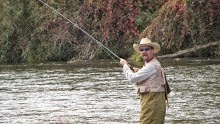
In responding to NorCal Cazadora in my previous post, in occurred to me that we could help solve the chicken-and-egg conundrum about hunters and environmentalists.
Oftentimes when I'm attending an environmental advocacy conference, I come across one or two people who would love to try fishing and/or hunting, but who don't know how to start. I often also come across open-minded hunters who absolutely love having new folks to show hunting. I propose, then, a Take an Environmentalist Hunting Day, and I mean that in the sincerest sense.
Many hunters believe that environmentalists and animal rights people are one and the same, but they are not. In fact, I don't even consider animal rights advocacy part of the environmental movement (with a couple of notable exceptions, of course), although I must admit that the fact that many members of nonprofit environmental groups also tend to be knee-jerk members of animal rights groups, which clouds the situation.
Many environmentalists believe that hunters today are paramilitary members who spend part of each year in a compound in Idaho and worry about the New World Order. However, they carry a romantic notion of the act of hunting, because they have grafted themselves to the Tree of Conservation, whose trunk is T.R. and Thomas Seton, and whose roots are their romantic notions of subsistence hunters and pre-Columbian folks in North America. They know that deep within their love of the wild exists a need to be the wild, to be a part of it in the most natural way possible, through getting some of their sustenance from it. They may salve that empty part of their hearts by telling their conscious selves that this is a New Era, and that hunting, today, doesn't have the same spirit and heart, but many long for the experience.
What happens, then, when we introduce enthusiastic environmentalists with the likes of Holly at NorCal Cazadora, Hank at Hunter, Angler, Gardener, Cook, Phillip at the Hog Blog, or Tovar Cerulli? And there are many, many more like them, ready to share their love for hunting and what it provides, physically, mentally, emotionally, and in some cases, spiritually.
Hunters, if you are so inclined, I recommend you seek out some of your more environmentalist acquaintances, talk up the beauty and experience of intimately knowing your habitats and gaining sustenance from them, and see what happens. You may end up with a new hunting partner, and helping to re-engage two artificially separated communities. But if it doesn't even go that far, I doubt you'll be disappointed in the conversation and the shared feelings about those things to which we all feel connected.
Addendum: If you are interested in hunting or fishing, but have never done so and don't know where or how to start, please shoot me an email, and I will do my darndest to find a hunter in your area who will give you more information, and may even want to meet you and help show you the ropes.
Showing posts with label wild. Show all posts
Showing posts with label wild. Show all posts
Thursday, October 28, 2010


Wednesday, October 27, 2010
Aldo Leopold, & why I don't see a difference between my hunting and environmentalism
© 2010 Joshua Stark
This morning, I read some of Aldo Leopold's, "A Sand County Almanac" to my son (he is one month old). If you are interested in understanding just why I cannot comprehend how hunters and fishermen don't consider themselves as brothers and sisters to environmentalists, or indeed, environmentalists, themselves, then please read the first three paragraphs of Mr. Leopold's foreword.
The spirit conveyed in this work, so beautifully put in those first paragraphs, lays bare the reasons that many of us hunt and fish.
The only thing separating us into different communities are other politics, and that is a crying shame.
Thoughts?
This morning, I read some of Aldo Leopold's, "A Sand County Almanac" to my son (he is one month old). If you are interested in understanding just why I cannot comprehend how hunters and fishermen don't consider themselves as brothers and sisters to environmentalists, or indeed, environmentalists, themselves, then please read the first three paragraphs of Mr. Leopold's foreword.
The spirit conveyed in this work, so beautifully put in those first paragraphs, lays bare the reasons that many of us hunt and fish.
The only thing separating us into different communities are other politics, and that is a crying shame.
Thoughts?
Monday, April 19, 2010
On Goose Music
© 2010 Joshua Stark
The famous chapter in Aldo Leopold's "A Sand County Almanac" on Goose Music always moves me, in particular because I grew up right smack in the middle of a major landing place for waterfowl in the Pacific Flyway, the Sacramento-San Joaquin Delta (for a great excerpt, check this out).
flx1247rg
The photo I've added above, for example, was taken in East Isleton, at the end of the street where I grew up, about 100 yards from where my parents still reside. Those are snow geese coming down in a neighboring field.
Nearly every Winter of my life I've lived with calls from overhead. I remember laying in bed at home in the middle of the night, hearing swans call to each other as they passed over town in the fog, flying so close that, with the window cracked a bit, I could hear their rhythmic breathing. I remember hearing the amazing, trumpeting calls of sandhill cranes, only a few when I was a boy, but more and more each year so that now we watch huge, swirling flocks come down in August and September. And I remember geese.
It seems that everybody has a neighborhood gaggle of honkers nowdays, and as Tovar Cerulli recently pointed out, there is at times something strange about the ease with which they can interact with our world. We have a flock passing over many mornings and evenings, and their calls still stir me, even if I know they are flying out to and back from their golf-course feeding grounds (no better use for a golf course, anyway). But I grew up close to wild geese, and I was blessed with the widest variety of big waterfowl around. Honkers of all sizes, swans, cranes, snows, blues. And specks.
Ever since I watched, from my elementary school playground, a big flock of specks take flight in 20 mph winds, and, buffeted, swing right overhead, I've been amazed by them. Their call is distinctive, too, often a higher pitched, two-note number, and it means that Fall fell, and Winter is here. Or, it means that Spring has sprung fully, and it's time for them to head up North to have babies, so they can come back home, here on the Delta.
Night before last, in my back yard, while I was putting the ducks to bed (I have three yard ducks), I heard a flock of specks passing over. As it was night, and mid-April, I knew they wouldn't be back for a few months. And although the arrival of Spring brings its own greatness, there is always a hollow in my heart, an empty space to be filled only with that two-note cry, now wending its way on North.
The famous chapter in Aldo Leopold's "A Sand County Almanac" on Goose Music always moves me, in particular because I grew up right smack in the middle of a major landing place for waterfowl in the Pacific Flyway, the Sacramento-San Joaquin Delta (for a great excerpt, check this out).
flx1247rg
The photo I've added above, for example, was taken in East Isleton, at the end of the street where I grew up, about 100 yards from where my parents still reside. Those are snow geese coming down in a neighboring field.
Nearly every Winter of my life I've lived with calls from overhead. I remember laying in bed at home in the middle of the night, hearing swans call to each other as they passed over town in the fog, flying so close that, with the window cracked a bit, I could hear their rhythmic breathing. I remember hearing the amazing, trumpeting calls of sandhill cranes, only a few when I was a boy, but more and more each year so that now we watch huge, swirling flocks come down in August and September. And I remember geese.
It seems that everybody has a neighborhood gaggle of honkers nowdays, and as Tovar Cerulli recently pointed out, there is at times something strange about the ease with which they can interact with our world. We have a flock passing over many mornings and evenings, and their calls still stir me, even if I know they are flying out to and back from their golf-course feeding grounds (no better use for a golf course, anyway). But I grew up close to wild geese, and I was blessed with the widest variety of big waterfowl around. Honkers of all sizes, swans, cranes, snows, blues. And specks.
Ever since I watched, from my elementary school playground, a big flock of specks take flight in 20 mph winds, and, buffeted, swing right overhead, I've been amazed by them. Their call is distinctive, too, often a higher pitched, two-note number, and it means that Fall fell, and Winter is here. Or, it means that Spring has sprung fully, and it's time for them to head up North to have babies, so they can come back home, here on the Delta.
Night before last, in my back yard, while I was putting the ducks to bed (I have three yard ducks), I heard a flock of specks passing over. As it was night, and mid-April, I knew they wouldn't be back for a few months. And although the arrival of Spring brings its own greatness, there is always a hollow in my heart, an empty space to be filled only with that two-note cry, now wending its way on North.
Monday, October 20, 2008
Enviros? Conservationists? Tree-huggers? Killers?
I love the political realm, for the most part, though I also hate it. In fact, my fascination with it probably has nearly as much to do with the emotions it stirs as it does with my personal belief that we are all responsible in our democratic republic. But, one place that really bothers me about political 'discourse' is the prevelance of half-formed ideas, urges and reactionism that get rolled up and kneaded into little soundbites, or worse, labels.
People are labeling creatures, we are ordering creatures. We create boxes of meaning into which we place ideas about people and things. Then we attach words to these boxes, for ease of use. This is very helpful in remembering, for example, that a particular mushroom killed Joe-Bob, or that cars with the word "Hyundai" on them may not be solid purchase decisions. However, when it comes to labeling groups of people in the political realm, we can really step on our own feet and hinder good management decisions.
Let me be perfectly clear here: The number one threat to the environment right now is unfettered development. Were we to efficiently manage our future development, and re-configure existing development, we could:
1) Help to effectively mitigate greenhouse gasses;
2) Much more effectively protect habitat and wildlife corridors;
3) Improve the health of our people;
4) Provide more opportunities for healthy outdoor connectedness, and more of a sense of place.
4) Provide more opportunities for healthy outdoor connectedness, and more of a sense of place.
I could go on, but those are the big four when it comes to our future.
So, why am I seemingly jumping from one topic to another? Because our current political climate has so polarized us on environmental issues that we cannot even speak in civilized tones about the environment, much less push effective legislation.
Hunters, think about it: What is the bigger deal, that you can't shoot a lead round in condor country, or that you can't shoot ANYTHING?
Nonhunters, think about this: Hunters killing deer in a forest managed mostly through their dollars, or no deer at all, because the forest is now a string of Kinkos, Targets, and ticky-tacks?
The political upheavals of the 1960's & 70's completed a great schism in the community of people who love nature. This schism has reached such heights, that now, when I write about these topics, I have to write convoluted sentences about the "environmental-conservation community", and probably stay away from words like "natural resources" or "movement". Even the words "environment" and "conservation" are loaded!
It's downright ridiculous.
Of the four major groups spawned by the first folks loving nature in the late 1800's, three of them can share in an honest attempt to rein in sprawl, protect valuable habitats and corridors, re-establish watersheds, wetlands and prairies, and any number of other important goals for places. These three groups are hunting organizations (like the Rocky Mountain Elk Foundation, SCI, Pheasants Forever), conservation groups (like Defenders of Wildlife, the Nature Conservancy), and environmental groups (like the Sierra Club and the Center for Biological Diversity).
The fourth group, believe it or not, is another symptom of unfettered development. In our expanding suburbs, with no real rivers or wild places, there grew a group of people who 'love' nature. They often have had little or no contact with it, with particular places or creatures, because of where they live and how they were raised. They have no experiences with death and life, realities of our world. They only think of these things in the horrific. In this vacuum, fed by an honest longing for nature and the wild, but with no way of getting the genuine experience, the animal rights movement was born. Of course, I'm labeling, and I know that many animal rights' proponents have had many experiences with the wild, but for the most part, of the folks I've run across, most have come from urban or suburban environs, and may have worked in healing or rescuing animals, but haven't really seen a cat catch a bird, and do not understand that death must occur for even their continued survival.
If the three major groups who care about the environment and have experience with it could honestly engage young people by helping to curb sprawl and create living places where kids can respectfully experience the wild, then we can also help develop people with a true understanding, and therefore appreciation, of that wild. To do that, we don't need to put down our differences about other conservative/liberal ideas. We just need to meet and stick to the subject.
Where do you see connections that can be made?
Nonhunters, think about this: Hunters killing deer in a forest managed mostly through their dollars, or no deer at all, because the forest is now a string of Kinkos, Targets, and ticky-tacks?
The political upheavals of the 1960's & 70's completed a great schism in the community of people who love nature. This schism has reached such heights, that now, when I write about these topics, I have to write convoluted sentences about the "environmental-conservation community", and probably stay away from words like "natural resources" or "movement". Even the words "environment" and "conservation" are loaded!
It's downright ridiculous.
Of the four major groups spawned by the first folks loving nature in the late 1800's, three of them can share in an honest attempt to rein in sprawl, protect valuable habitats and corridors, re-establish watersheds, wetlands and prairies, and any number of other important goals for places. These three groups are hunting organizations (like the Rocky Mountain Elk Foundation, SCI, Pheasants Forever), conservation groups (like Defenders of Wildlife, the Nature Conservancy), and environmental groups (like the Sierra Club and the Center for Biological Diversity).
The fourth group, believe it or not, is another symptom of unfettered development. In our expanding suburbs, with no real rivers or wild places, there grew a group of people who 'love' nature. They often have had little or no contact with it, with particular places or creatures, because of where they live and how they were raised. They have no experiences with death and life, realities of our world. They only think of these things in the horrific. In this vacuum, fed by an honest longing for nature and the wild, but with no way of getting the genuine experience, the animal rights movement was born. Of course, I'm labeling, and I know that many animal rights' proponents have had many experiences with the wild, but for the most part, of the folks I've run across, most have come from urban or suburban environs, and may have worked in healing or rescuing animals, but haven't really seen a cat catch a bird, and do not understand that death must occur for even their continued survival.
If the three major groups who care about the environment and have experience with it could honestly engage young people by helping to curb sprawl and create living places where kids can respectfully experience the wild, then we can also help develop people with a true understanding, and therefore appreciation, of that wild. To do that, we don't need to put down our differences about other conservative/liberal ideas. We just need to meet and stick to the subject.
Where do you see connections that can be made?
Wednesday, May 14, 2008
What are "urban" and "rural", anyway?
Three minor events in my life conspired to get me to think about the nature of our geographic construction. In college, way back in the last century, I saw a 'possum. Later, still in college, I saw a coyote. Last, a few years ago I saw a show on PBS about a hawk, a show I thought was curious and at times very silly. What was so unusual about these events?
The first was in Fullerton, California. Walking home from school, this 'possum "runs" (if you can call it that) across the street, trips on the curb, then crawls into a very sparse shrub where it sits stock still and pretends I don't see it. I also pretended I didn't see it, and walked on home. The second event was at Griffith Park in Los Angeles. After a concert, looking for my car in the parking lot, a coyote trots by. The third was the famous (or infamous) PBS show, "Pale Male", about a red-tailed hawk that takes up residence in and around Central Park in New York City. I watched this show with a very skeptical eye, unable to believe that red-tailed hawks had never always lived wherever they durn well please.
Slowly, these events converged, and led me to an understanding:
There is no such thing as rural or urban.
Where is this line in reality? I posit that it does not exist. Start with the line itself. City limits are drawn and redrawn, lands annexed and assigned development titles (even for parks), but this means nothing in the real world. Large, ecologically diverse parks exist in the middle of cities (for the best example, take a boat trip down the Lower American River in Sacramento), but habitat occurs even in the most concrete of jungles. Raccoons, skunks, opossums and coyotes, sizeable mammals, live in the downtown sections of just about every major city in the country, as do countless birds, bats, and bugs. Roads slither in and out of cities, bringing urban effects far into the countryside and vice-versa. Nor does air quality stop at the city limit: Sequoia National Park has the worst air quality of any national park in the country. The same goes for water and soil pollution, as well.
Many wild songbirds are saved on their flights by folks in cities placing feed out where once the birds could have found forage habitat. Are these backyard havens urban, or rural? Many other birds die, their once fertile habitat now mile after mile of corn. This corn is grown for the city - is it rural or urban?
I watched the PBS special, loving the people who were passionate about those crazy birds. I was disappointed that it was about one bird, even though he'd had multiple mates and many children (where were all of these coming from or leaving to?) I laughed out loud when they showed a picture of a great horned owl during the introduction, but didn't consider it as "wild" as the hawk (the great-horned owl is known as the Tiger of the woods, and regularly eats skunks, as well as herons, egrets, and yes, the occasional red-tailed hawk). But mostly I was amazed that people didn't see these hawks until one nested on a high-rise next to Mary Tyler Moore. Every day I spend in every city I see raptors - redtails, red shoulders, coopers, kestrels. I've even seen Swainson's hawks and ospreys well within the designated border between the rural and wild places. I guess they didn't get the memo.
"Rural" and "Urban" don't exist. They help with some management decisions, but for the most part they give people a false sense of separation from place, and from reality.
The first was in Fullerton, California. Walking home from school, this 'possum "runs" (if you can call it that) across the street, trips on the curb, then crawls into a very sparse shrub where it sits stock still and pretends I don't see it. I also pretended I didn't see it, and walked on home. The second event was at Griffith Park in Los Angeles. After a concert, looking for my car in the parking lot, a coyote trots by. The third was the famous (or infamous) PBS show, "Pale Male", about a red-tailed hawk that takes up residence in and around Central Park in New York City. I watched this show with a very skeptical eye, unable to believe that red-tailed hawks had never always lived wherever they durn well please.
Slowly, these events converged, and led me to an understanding:
There is no such thing as rural or urban.
Where is this line in reality? I posit that it does not exist. Start with the line itself. City limits are drawn and redrawn, lands annexed and assigned development titles (even for parks), but this means nothing in the real world. Large, ecologically diverse parks exist in the middle of cities (for the best example, take a boat trip down the Lower American River in Sacramento), but habitat occurs even in the most concrete of jungles. Raccoons, skunks, opossums and coyotes, sizeable mammals, live in the downtown sections of just about every major city in the country, as do countless birds, bats, and bugs. Roads slither in and out of cities, bringing urban effects far into the countryside and vice-versa. Nor does air quality stop at the city limit: Sequoia National Park has the worst air quality of any national park in the country. The same goes for water and soil pollution, as well.
Many wild songbirds are saved on their flights by folks in cities placing feed out where once the birds could have found forage habitat. Are these backyard havens urban, or rural? Many other birds die, their once fertile habitat now mile after mile of corn. This corn is grown for the city - is it rural or urban?
I watched the PBS special, loving the people who were passionate about those crazy birds. I was disappointed that it was about one bird, even though he'd had multiple mates and many children (where were all of these coming from or leaving to?) I laughed out loud when they showed a picture of a great horned owl during the introduction, but didn't consider it as "wild" as the hawk (the great-horned owl is known as the Tiger of the woods, and regularly eats skunks, as well as herons, egrets, and yes, the occasional red-tailed hawk). But mostly I was amazed that people didn't see these hawks until one nested on a high-rise next to Mary Tyler Moore. Every day I spend in every city I see raptors - redtails, red shoulders, coopers, kestrels. I've even seen Swainson's hawks and ospreys well within the designated border between the rural and wild places. I guess they didn't get the memo.
"Rural" and "Urban" don't exist. They help with some management decisions, but for the most part they give people a false sense of separation from place, and from reality.
Subscribe to:
Posts (Atom)