


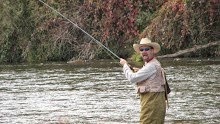
© 2010 Joshua Stark
Though I grew up rural, I never got into 4-H. We didn't have land, and we were never an animal-husbandry type family.
As an adult, however, I've become very interested in the agrarian life, and how it can apply to my own condition (if you are interested in reading about my semi-urban homesteading attempts, please read my other blog, Agrarianista). Most recently, I applied for (and I believe, subsequently did not get) a position with the Sacramento County 4-H.
I was interested in all the work they've done providing experiences to young people, and in researching today's 4-H, I was very impressed with the types of activities and roles they offer kids from pre-school through high school. 4-H focuses on getting kids to "learn by doing", a model for teaching that is dear to my heart, and also an effective pedagogy. Today, 4-H works to get to urban youth as well as rural kids, with programs that give children the opportunity to practice environmental sciences and sleep out under the stars, as well as learn agricultural and homesteading skills.
Of course, I am especially impressed with the 4-H Shooting Sports category. I've been interested in getting young people involved in shooting, but without the politics associated with the groups who offer such services, and 4-H offers just that: the opportunity to teach kids how to shoot and how to interact with the outdoors (both the wild and the farmland), while giving them the breathing room to enjoy the experiences.
If you are interested in passing on your knowledge about the wild, about farming and food, about the interconnectedness of the urban, rural, and wild places, then contact your local 4-H and volunteer today.
http://www.4-h.org/
Showing posts with label youth. Show all posts
Showing posts with label youth. Show all posts
Sunday, December 12, 2010


Wednesday, December 31, 2008
Environmental Justice and hunting groups together? Why not!
These two groups are about as far from each other on a traditional political spectrum as can be, but the political spectrum is irrelevant to conservationism. First, a little background:
By "hunting groups", I mean to include those organizations whose original impetus for creation came from hunting. In my mind, this includes folks like The Wild Turkey Foundation, the Rocky Mountain Elk Foundation, Ducks Unlimited, the California Waterfowl Association, etc. These groups are largely made up of older white males, people who care deeply about hunting as a tradition and the wild as a necessary component to humanity. These are people who often cradle baby chicks in their hands, understand animal husbandry as well as shooting, and think hard about a conservation ethic.
By "environmental justice groups", I mean to include those organizations whose original impetus for creation came from an outrage against pollution in their immediate communities. This includes groups like Citizens Against Waste, the Coalition for Clean Air, the Verde Group, the Center on Race, Poverty & the Environment, etc. These groups are largely made up of poor and disenfranchised folks who have organized out of a sense of outrage and a desire to protect their towns, neighborhoods, and children. These are people who see lung cancer rates in some places at 1,000 times the national average, folks with a quarter of their kids suffering from asthma, people who are literally fighting to keep other people's poop from being dumped on them.
Now, these two cliques, as radically different as they seem on the surface, share some remarkably deep traits. Both grew out of battles against huge businesses and business trends, fighting and beating major corporate interests. Both have a deep sense of conviction and an evangelical streak when it comes to their passion. And both serve large, more socially conservative constituents who enjoy the outdoors.
Hunting groups tend to forget just how radical were their ideas when first proposed: Huge tracts of land taken completely off the market, owned and managed by the government or quasi-governmental institutions and run by volunteers, not profit; species and entire habitats protected from hunting; water quality improvements forced on major companies. Many hunters can, with pride, talk about the conservation efforts of the hunting community and our conservation forefathers like TR and George Grinnell, but doing so means that we are proud to support government efforts that curbed business interests for the greater common good.
On the other hand, many EJ groups represent constituents who trend more socially conservative than the typical environmental policy analyst. EJ communities tend to be deeply religious, are usually one generation or less from the farm or the wilds, and carry a strong fishing and hunting tradition. Today, many folks who live in EJ communities can be found fishing local ditches for carp and bass, hunting the National Forest and BLM lands for deer, squirrel, and quail, and, increasingly, showing up at the local wildlife refuges for ducks and geese.
Now is a great time for these two communities to get into active conversations and cooperative arrangements, and two places where this seems a natural fit are in community/youth outreach, and work on public policy. Both groups are fighting to stay relevant to young people, and each group has something to offer the other - they both currently cater to very different people, yet these people could mesh well. Setting up information booths at each others' outreach events would be a great start, with each group bringing their strength: EJ groups, bring the kids, urban youth, and their parents, who know how to hunt and know the land; hunting groups, bring baby birds, bring recipes and sausages and video of ducks and deer. Heck, bring guns - people like to shoot guns, it's fun.
The political policy realm may be a bit trickier for these two groups, as they tend to fall on different sides of the political spectrum, but there are many common goals, and their political tendencies can result in some major victories. My recommendation? Work on a local public lands access issue or clean-up effort. These make for good media, and can bring together pretty diverse people for a common, and reachable, goal.
In our current economic climate, conservation efforts are going to take a hit, both at the public policy and individual levels. Cooperative efforts are vital at this point, and they are also vital in the long run. These two groups have important things to share, and their cooperation could take the establishment by surprise and by storm. It would be just in time.
Subscribe to:
Posts (Atom)